1 Big Idea: The Year Is a Roll of the Dice
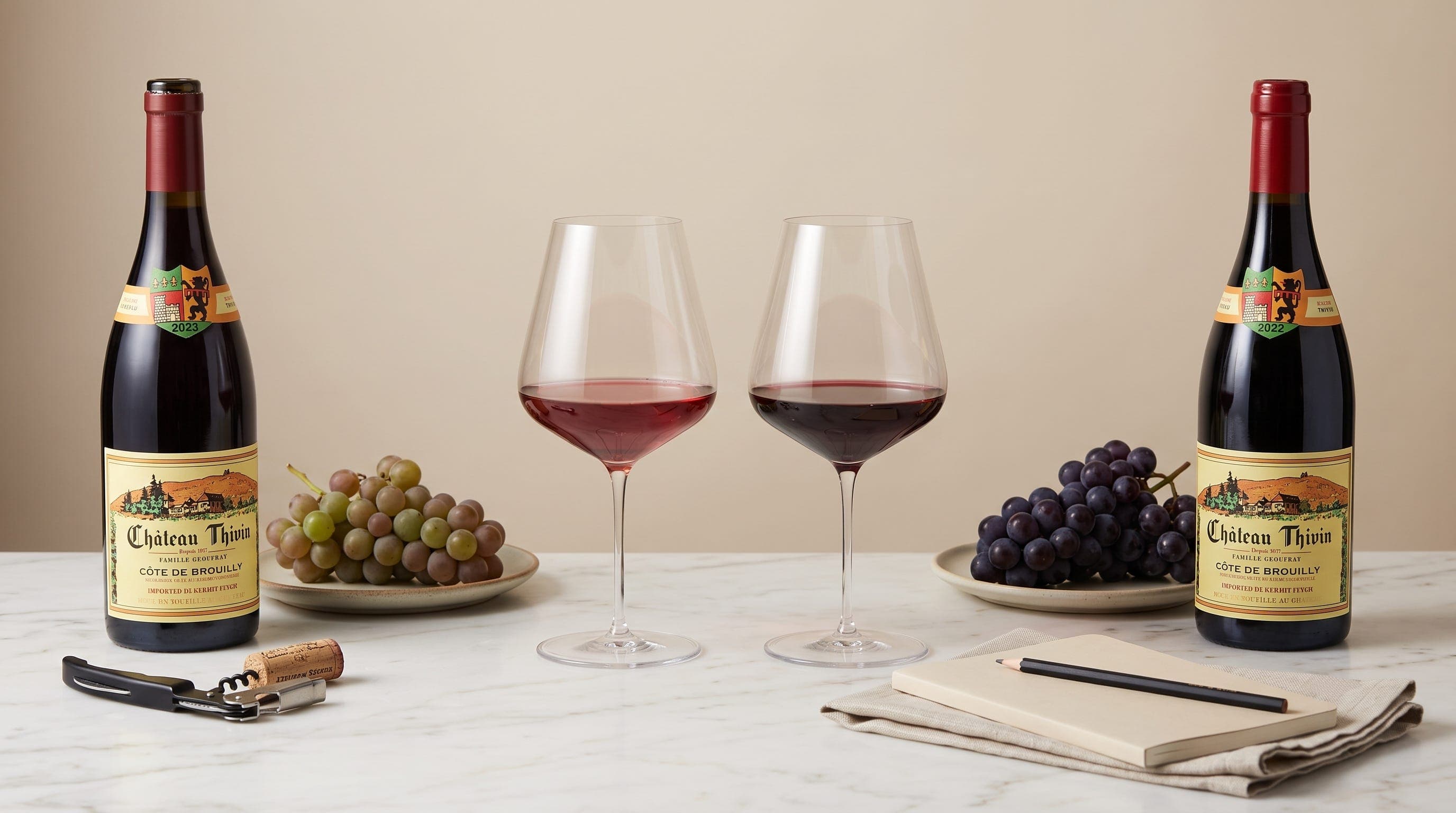
I once had two vintages of the same red Burgundy open by the glass on the same night, the same producer, the same vineyard, one year apart. Guests who tried both kept insisting I had mixed up the bottles. One was pale, tart, and nervous. The other was darker, rounder, and riper. Same wine, same hands. The only thing that changed was the weather of a single summer.
If you have ever rebought a bottle you loved and met a subtly different wine, you were not imagining it. That is the whole idea of vintage, and it gets confused with something we talked about a few weeks ago.
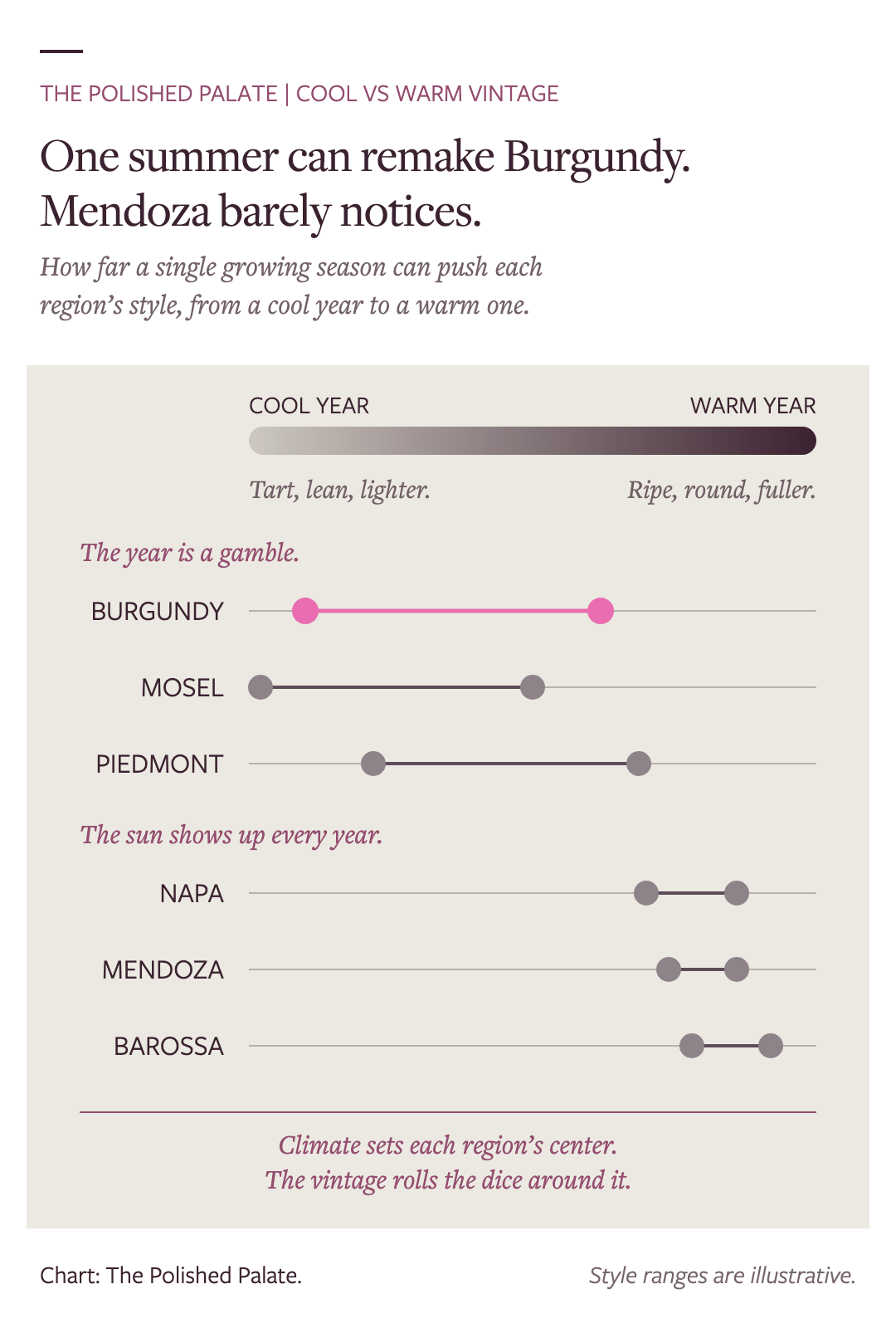
Climate is the baseline a region gets every year, its long-term average of heat and cool. Vintage is the dice roll on top of that baseline, the actual weather of one growing season. A cool, cloudy, late-ripening year leaves grapes with higher acid, lower sugar, lighter body, and a leaner, more savory style. A warm, sunny year pushes the opposite way, riper fruit, more alcohol, softer acid, a fuller and rounder wine.
Here is the part that turns this into a practical skill. Vintage matters enormously in some places and almost not at all in others, and knowing which is which saves you money and disappointment at the shop.
In cool, marginal regions, the kind that struggle to ripen grapes in the first place, one bad summer can be the difference between a great wine and a thin one. This is why people obsess over the year in Burgundy, Bordeaux, Champagne, the Mosel, and Piedmont. The weather there is a genuine gamble, so the vintage is real information.
In reliably warm regions, the sun shows up every year. Napa, Barossa, Mendoza, and most of the warm New World ripen fruit dependably, so the swing from year to year is small. The vintage on those labels is closer to a formality.
Three Taste Experiments
Two of these pairs ask you to do something easy that most people never try: buy two different vintages of the exact same wine and taste them together. Any decent shop can pull two adjacent years of a bottling for you. If yours carries only the current release, ask which bottlings they stock across years, or buy one bottle now and the next after the vintage rolls over. The third pair shows the concept a different way. Taste with water and plain bread between, and notice ripeness, body, and how soft or sharp the acid feels.
#1: Two Vintages of One Cool-Region Wine
Objective: Feel a real vintage swing in a place where the weather is a gamble.
What to try: Two different vintages, one year apart, of a single cool-region wine. A village-level Chablis such as Louis Michel & Fils or William Fèvre “Champs Royaux,” roughly $25 to $32, or a cru Beaujolais such as Château Thivin Côte de Brouilly or Domaine Dupeuble Beaujolais, roughly $18 to $30. Ask your shop to pull whatever two adjacent years they have of the same bottling.
What to notice: Set them side by side and the differences jump out. One year will likely feel leaner, tarter, and lighter; the other riper, rounder, and a touch stronger. Same label, same producer, two summers. The gap you are tasting is pure weather.
Lesson: In a cool region, the year is real information. This is the swing the vintage charts are actually tracking.
#2: Two Vintages of One Warm-Region Wine
Objective: Run the same test where the sun is dependable, and watch the swing shrink.
What to try: Two adjacent vintages of a single warm-region red, such as Catena Malbec (Mendoza), Montes Alpha Cabernet Sauvignon (Colchagua), or d’Arenberg “The Footbolt” Shiraz (McLaren Vale), roughly $18 to $26 per bottle.
What to notice: Taste them together and the two years feel close, maybe nearly identical. A little more or less ripeness, perhaps, but nothing like the gap in the first pair. The reliable sun did the same job both seasons.
Lesson: In a warm region, the vintage barely moves the wine. Memorizing a chart for these places is effort spent on a difference you can hardly taste.
#3: Non-Vintage vs Vintage Sparkling
Objective: Taste the two opposite strategies producers use to handle vintage swings.
What to try: A non-vintage Champagne or traditional-method sparkling such as Lanson Black Label or Veuve Clicquot Yellow Label, roughly $50 to $60. Then a vintage-dated sparkling, declared only in strong years, such as a vintage Champagne or, for a gentler price, a vintage-dated Crémant or English sparkling, roughly $35 to $70.
What to notice: The non-vintage is a deliberate blend across several years, built to taste the same every time you buy it, the house erasing vintage on purpose. The vintage bottle is a single, strong year captured on its own, usually more distinctive and expressive. One smooths the weather out. The other puts a single season on a pedestal.
Lesson: Non-vintage exists to defeat vintage swing. A declared vintage exists to celebrate one. Tasting them together shows you both philosophies in one sitting.
Pocket Palate: when the vintage matters
The vintage on the label is information in some places and noise in others.
- It matters: Burgundy, Bordeaux, Champagne, Mosel, Piedmont. Weather is a gamble.
- It barely matters: Napa, Barossa, Mendoza. The sun shows up every year.
- The swing: Cool years run tart and lean; warm years run ripe and round.
- The habit: Love a bottle? Note its vintage, then try the year on either side.
- The point: The vintage is a dice roll.
The Finish
By now the year on a label has stopped being decoration and started being a clue. You know that in cool, marginal regions a vintage carries real information about whether a wine will lean tart and lithe or ripe and round, and that in dependable warm regions the same number tells you very little. That alone puts you ahead of most people staring at a shelf.
Use it as a tool, never a master. A vintage chart predicts a style; it does not rank your enjoyment, and plenty of so-called lesser years make wines that will resonate with you more than the celebrated ones. The point is to predict a style, then trust your own palate on whether you want it.
So this week, when you find a wine you love, write down its vintage. Next time, try the year on either side of it and notice whether the change is dramatic or barely there. That one habit tells you, better than any chart, how much the year actually matters for the wines you drink.
Go Deeper
If this week’s idea stuck with you, these take it further.
- Madeline Puckette, “Wine Vintages and Why They Matter” (Wine Folly): A clear, visual explanation of what a vintage is and why some regions live and die by it, the easiest on-ramp to the idea.
- Vintages (Berry Bros. & Rudd): A long-running merchant’s vintage resource, useful for seeing which regions swing hard year to year and which stay flat, the practical version of this issue’s lesson.
- Karen MacNeil, The Wine Bible, 3rd ed. (Workman Publishing, 2022): The accessible reference whose regional chapters flag, place by place, how much the year actually matters.