1 Big Idea: The Vineyard Sets the Backbone
A guest once waved off an Argentine white I suggested, certain that anything from a place that hot would taste like warm fruit juice. I poured it anyway. It came from vineyards more than a mile above sea level, and it hit the table electric, all lime and salt and cut. He took another sip, then asked to see the bottle.
The vineyard sits high enough that the nights stay cold, and that is what he was tasting.
If you have ever passed on a bottle because the region sounded too hot, you have made the same bet, and it loses for a reason you can learn in one evening.
Acidity is the freshness that makes a wine feel alive, the thing that makes your mouth water and keeps a wine from tasting heavy. By now you know how much you rely on it. What most drinkers never learn is that acidity is largely decided in the vineyard, long before fermentation, by three features of the site itself.
- The first is altitude. The higher a vineyard climbs, the colder its nights get, even when the days are scorching. Grapes build sugar in the heat of the day and hold on to acid in the cold of the night, so a high mountain vineyard can ripen fruit fully while keeping the freshness a hot valley floor would have cooked away. This is why a wine from the Andes or the slopes of a volcano can out-fresh a wine from a mild coast.
- The second is aspect, the direction a slope faces. A slope tilted toward the sun catches more light and ripens faster. A slope angled away, or set in a cool river valley, ripens slowly and clings to its acid. The same grape on two faces of the same hill becomes two different wines.
- The third is soil. Pale, stony, well-draining ground reflects light and stresses the vine, which tends to give fresher, more structured wine. Rich, deep, water-holding soil grows fatter, softer fruit. Volcanic and limestone soils in particular have a reputation for wines that feel taut and mineral.
Put together, these three are why two wines from equally hot places can sit at opposite ends of the freshness scale. When a warm-country wine tastes bright and lifted, that freshness comes from the vineyard, one planted high, angled right, or rooted in the right soil.
3 Taste Experiments
Each pair this week puts one of the three site forces on display. All three hold the grape steady and move only the geography, so whatever you taste comes from the site and not the variety. Taste them side by side, with water and plain bread between, and chase one sensation in particular: how much your mouth waters after you swallow.
#1: High-Altitude Malbec vs Valley-Floor Malbec
Objective: Taste what a mile of elevation does to freshness in a hot climate.
What to try: A high-altitude Malbec such as Colomé “Estate” (Salta), Catena Zapata “Catena” Malbec (high-altitude Mendoza), or Susana Balbo “Crios,” roughly $18 to $28. Then an everyday valley-floor Malbec such as Alamos, Trapiche “Oak Cask,” or Norton “Barrel Select,” roughly $11 to $14.
What to notice: The high-altitude wine, despite coming from one of the sunniest wine regions on earth, stays lifted and firm, with violet, fresh plum, and a cool line of acidity holding the fruit up. The valley-floor Malbec is softer and rounder, riper and jammier, with the freshness sitting lower. Same grape, same country, a mile of elevation between them.
Lesson: Altitude bought the cold nights that kept the acid. That freshness was decided by the map, not the cellar.
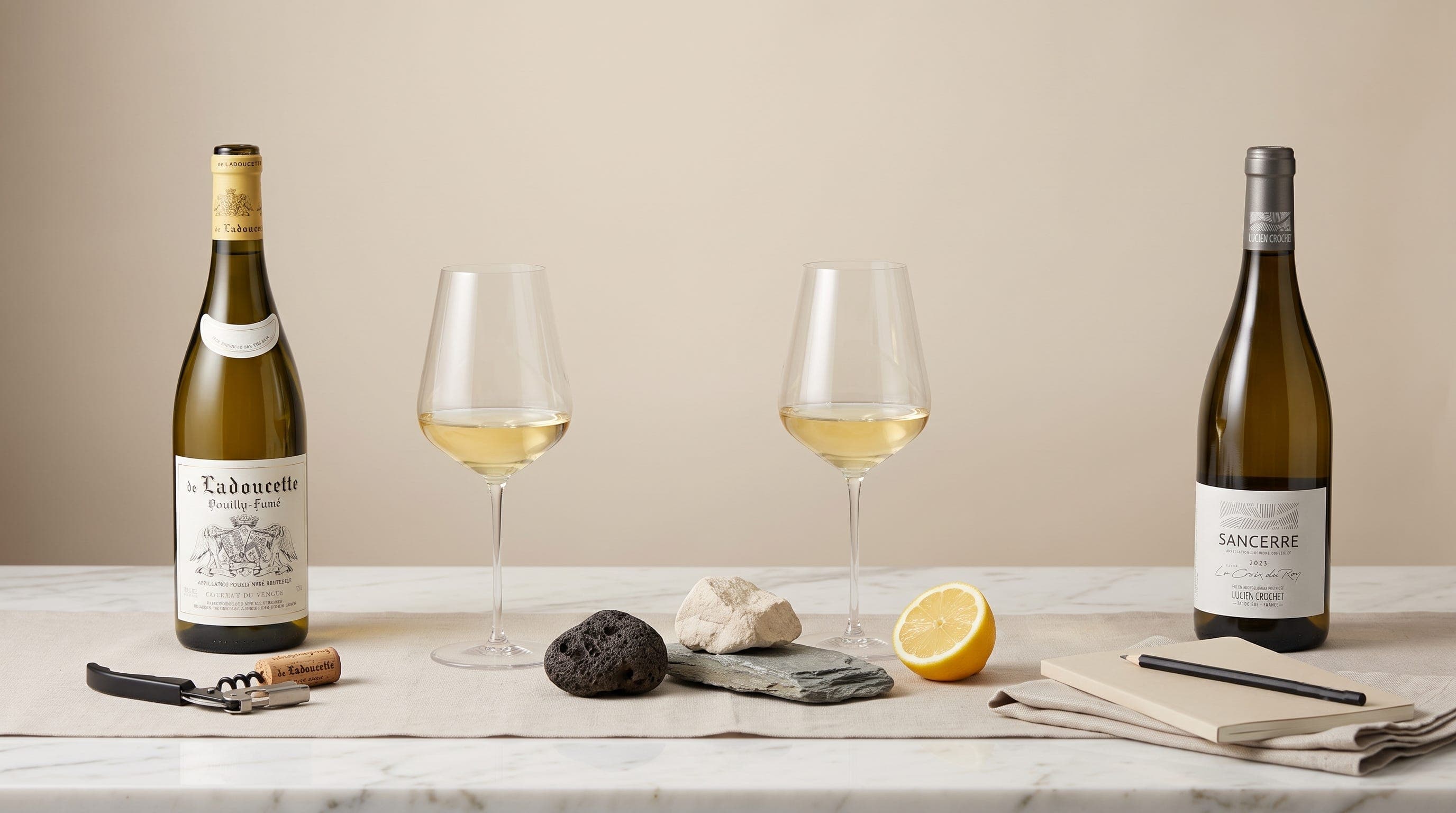
#2: Flint-Soil Pouilly-Fumé vs Limestone Sancerre
Objective: Taste what soil alone does, with the same grape in the same climate and only the rock under the vine changing.
What to try: A Pouilly-Fumé, grown on flinty silex soil, such as Michel Redde, Château de Tracy, or de Ladoucette, roughly $22 to $35. Then a Sancerre from the limestone slopes across the river such as Henri Bourgeois “Les Baronnes,” Pascal Jolivet, or Lucien Crochet, roughly $25 to $35.
What to notice: The Pouilly-Fumé carries a smoky, struck-flint edge over taut citrus, with a slightly firmer texture. The Sancerre is higher-toned and leaner, lime and white flowers and a chalky snap. The acid stays close between the two. What moves is texture and mineral character, the smoky flint of one against the chalk of the other. Same grape, same climate, one river between them, and only the ground changed.
Lesson: Nothing moved but the soil, and the wines still diverged. Soil is the hardest of the three forces to taste, because its mark is texture and mineral character more than a jump in acidity. You can only read it when altitude, aspect, and climate are held still, which is what this pair does.
#3: Steep-Slope Mosel Riesling vs Flat Warm-Site Riesling
Objective: Taste aspect and slope by comparing Riesling grown on a near-vertical cool hillside against Riesling from flat, warm ground.
What to try: A steep-slope Mosel Riesling (grown on dark slate hills angled to catch low northern sun) such as Dr. Loosen “Blue Slate” or Estate Riesling, Selbach-Oster Riesling, or Leitz, roughly $16 to $24. Then a flat warm-site Riesling such as Chateau Ste. Michelle (Columbia Valley) or Jacob’s Creek Riesling (South Eastern Australia), roughly $9 to $13.
What to notice: The Mosel is taut and low in alcohol, with green apple, lime, white flowers, and a mouthwatering snap that comes from a cold region ripening grapes only because the steep dark slate soaks up every bit of sun. The warm-site Riesling is rounder, riper, and softer, the same grape grown where ripening is easy and acid comes cheap. The slope did the work.
Lesson: A vine planted on a steep, sun-angled, heat-holding slope in a cold place gives a wine its tension. Flatten the site and warm it, and the tension relaxes.
Pocket Palate: where freshness comes from
Acidity is set by the site before the winemaker touches it.
- Altitude: Hot days build sugar, cold high-elevation nights save acid.
- Aspect: Sun-facing slopes ripen fast and soften. Angled-away slopes stay tense.
- Soil: Pale, stony, draining ground gives taut wine. Deep rich ground gives soft wine.
- The test: Warm region, electric freshness? Look up the elevation, slope, or rock.
- The point: Freshness is grown, then kept.
The Finish
Three pairs, one backbone. By now you have felt where the freshness you reach for actually comes from. It is grown, set into the grape by how high the vineyard sits, which way it leans, and what it is rooted in. That is the deeper layer under the climate idea from a few weeks back: climate sets a region’s average, and altitude, aspect, and soil are how a single vineyard escapes or exaggerates that average.
You do not need to memorize geology. You need to connect a sensation to a cause. When a wine tastes thrillingly fresh and you know it came from somewhere hot, that is your cue to go look at where it was grown.
So this week, find a wine that surprised you with its freshness and read its back label and a quick search for one fact: its elevation, its region’s slopes, or its soil. Watch how often the freshness you loved traces straight back to the ground.
Go Deeper
If this week’s idea stuck with you, these take it further.
- Madeline Puckette, “Understanding Acidity in Wine” (Wine Folly): A friendly primer on what acidity is and how climate and site push it up or down, for grounding before the technical reading.
- Understanding Acidity in Wine (Wine & Spirit Education Trust): The educator’s view of where a wine’s acidity comes from and how growers manage it, from the body that certifies most of the trade.
- John Gladstones, Viticulture and Environment, 2nd ed. (Trivinum Press, 2021): The viticultural classic on how altitude, slope, aspect, and soil govern the way a grape ripens and holds its acid, for readers who want the mechanism behind all three forces.