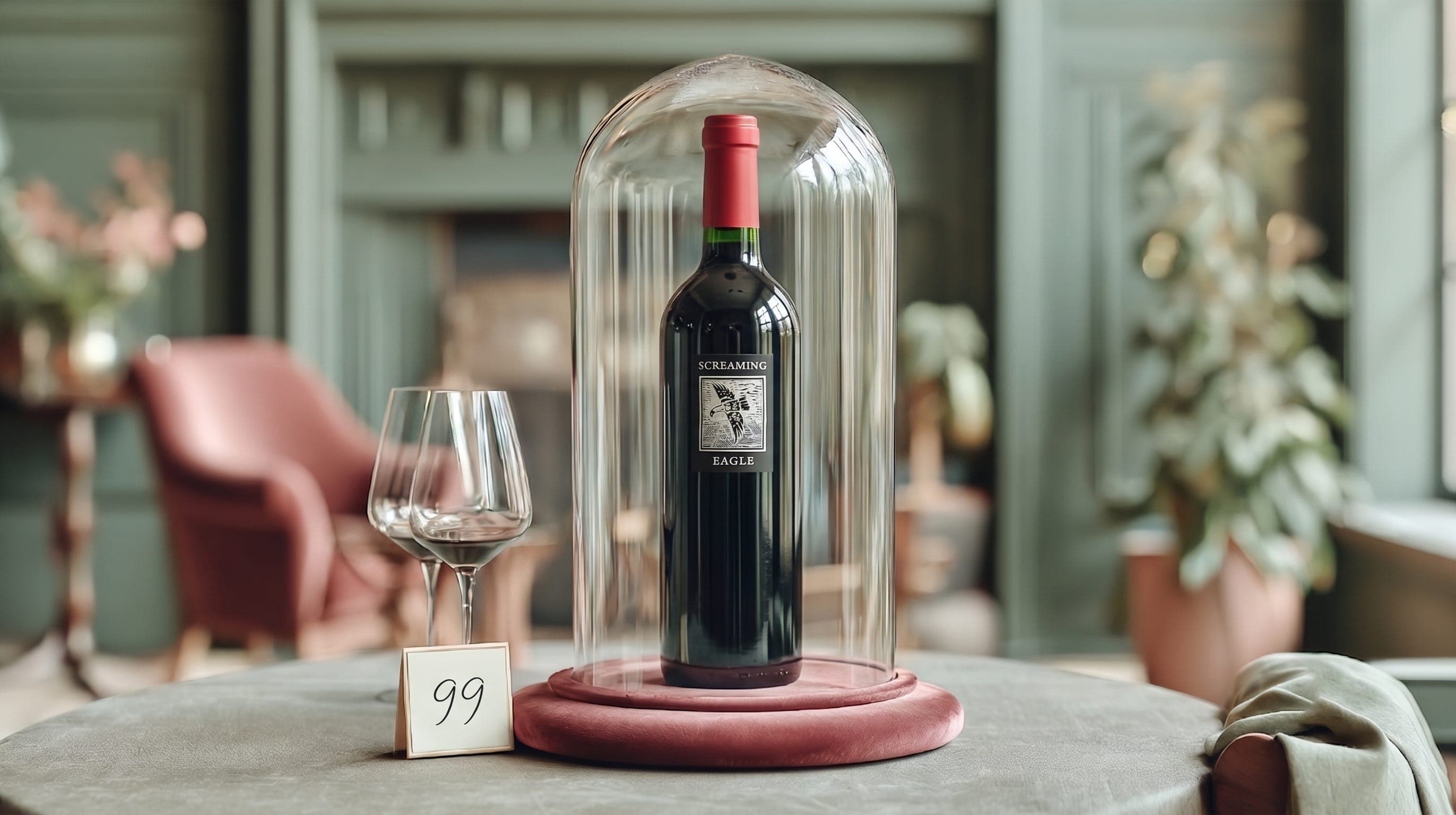
In 2000, a single six-liter bottle of Cabernet Sauvignon sold for $500,000 at a charity auction in Napa Valley. It had no château, no centuries of pedigree, no famous family name on the label. The winery that made it was eight years old. The bottle was one of only two of its size in existence, and the wine inside came from a vineyard in Oakville that a former real estate agent had planted almost by accident.
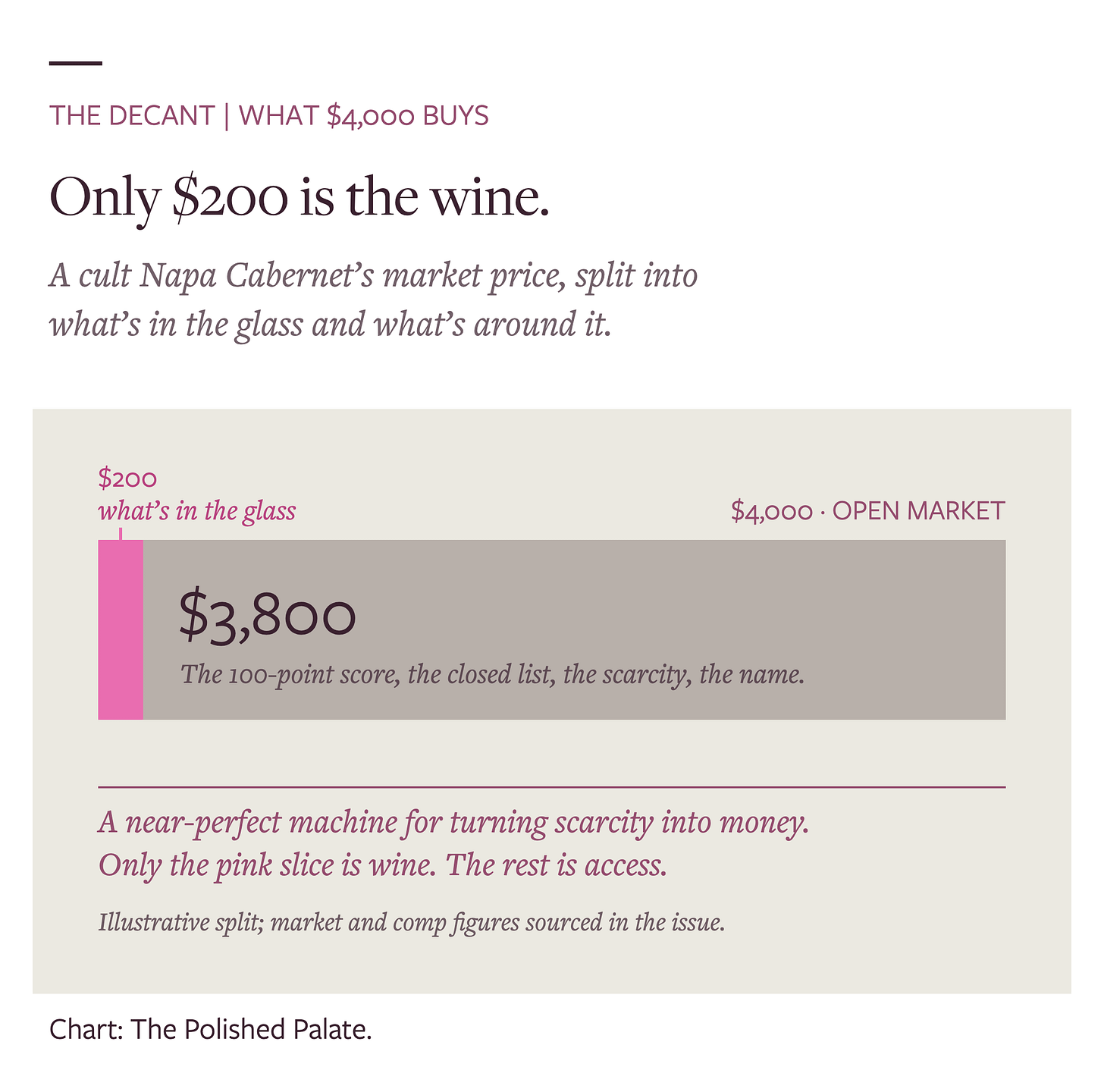
The wine was Screaming Eagle, and that auction lot is where the modern American cult Cabernet was born as a financial object. Twenty-six years later, a standard bottle of Screaming Eagle costs around $4,000 on the open market.
Almost no one who orders a bottle like this at a restaurant is in it for the wine. They are ordering the name. This week is about what the name is attached to, and what the $4,000 is really paying for.
A one-acre accident
Jean Phillips bought a 57-acre property on the Oakville bench in 1986. She was a real estate agent who liked wine, and for years she did the sensible thing: she sold most of the grapes to other Napa wineries and kept the land as an investment. One small block of Cabernet Sauvignon she held back to make a little wine of her own.
To make it well, she brought in Heidi Peterson Barrett, who would go on to be called the most celebrated winemaker in California.
The first commercial vintage, the 1992, was tiny. When it was released in 1995, Robert Parker scored it 99 points. That number did to Screaming Eagle what a 99-point score did to a dozen Napa labels in the 1990s: it converted a wine almost no one had tasted into a wine everyone suddenly needed.
The 1997 vintage earned a perfect 100 from Parker. By then the waiting list to buy a bottle directly was already years long. In 2006 Phillips sold the winery, reportedly for around $30 million, and since 2009 it has belonged outright to Stan Kroenke, the American sports magnate who owns the Los Angeles Rams and Arsenal. A one-acre hobby had become a trophy asset.
The scarcity machine
Screaming Eagle makes a famously small amount of wine, somewhere between a few hundred and around eight hundred cases in most vintages. A mid-sized Napa winery makes tens of thousands of cases a year. Screaming Eagle’s entire production is a rounding error next to that.
The only official way to buy it is the mailing list, and the mailing list has been closed to new members since around 2000. People who hold an allocation guard it the way others guard a rent-controlled apartment. Members pay roughly $1,000 a bottle. Everyone else pays the market, and the market is where the $4,000 lives.
This is the engine, and it is not unique to one label. The same machine built Harlan Estate, Colgin, Bryant Family, Dalla Valle, and Scarecrow. Bryant Family’s 1997 also earned a perfect 100 from Parker. Colgin has collected a long row of perfect scores across its vintages.
Three ingredients recur every time: a critic’s number near the ceiling, a production figure small enough to guarantee shortage, and a closed door. Demand is manufactured by limiting supply and then certifying quality with a score out of 100.
I wrote about where that score comes from, and why it deserves your suspicion, in the Decant piece on the 100-point system.
What’s actually in the glass
Here is the part the price tag obscures. The wine is genuinely very good. Screaming Eagle is Cabernet Sauvignon from old, well-sited Oakville vines, farmed at low yields, picked in tiny selective passes, fermented carefully, and aged in a cellar full of new French oak. Every one of those decisions costs money and improves the wine, and a serious taster will find real concentration, real structure, and a long life ahead in the bottle.
But none of that explains $4,000. Excellent Oakville Cabernet from neighboring vineyards, farmed with the same care and aged in the same kind of oak, sells for $75 to $200.
The distance from $200 to $4,000 is not in the glass. That stretch is pure access: the 100-point score, the closed list, the auction theater, and the plain shortage of the wine itself. You are buying scarcity and a number, and both of those carry real market value. Neither one is a flavor.
Netflix is about to lean on this. Darren Star’s Napa-set series, Uncorked, will use bottles like these the way film always uses wine, as shorthand for money and arrival. A character will order the trophy, and the audience will read it as taste. The more useful read is the one a sommelier learns at the table: the trophy tells you about a wallet and a waiting list, and very little about a palate.
The 1976 Judgment of Paris gave Napa permission to charge these prices. What you do with that information at your own table is a separate question.
The honest version of the lesson
You do not need Screaming Eagle, and chasing it is a fast way to spend a fortune on someone else’s idea of greatness while your own palate goes untrained. If you want to understand what great Oakville Cabernet tastes like, the lesson is available for under $100.
Look for bottles from the same valley that never caught a perfect score: a wine from a producer like Corison, Frog’s Leap, or Chappellet will teach you more about Napa, glass for glass, than a four-figure bottle you are too nervous to actually open.
The cult Cabernet is one of the most interesting objects in American wine, and it is worth understanding exactly. It is a near-perfect machine for converting scarcity into money. Understanding the machine is free. Trusting your own palate over its price tag is the entire point.
Go Deeper
If this week’s idea stuck with you, these take it further.
- Hannah Staab, How Screaming Eagle Became a Cult Wine (VinePair, 2025): A clear, free history of the Jean Phillips years and the rise of the label.
- The History of Cult Wines in the U.S. (Wine Enthusiast): The broader landscape of how Harlan, Colgin, Bryant, and the rest were built on the same model.
- James Laube and Daniel Sogg, Screaming Eagle Sold (Wine Spectator, 2006): Trade coverage of the 2006 sale that ended the Phillips era.
- 2000 Wine Auction Press Release (Napa Valley Vintners): The primary record of the $500,000 six-liter bottle and the auction that set it.