1 Big Idea: Your Nose Tastes Fruit, Your Tongue Tastes Sugar
Years ago, a Kiwi guest waved off the wine list before I had set it on the table. Nothing sweet, she said, she only drank dry wines. I poured her a taste of a Paso Cab, a wine with zero grams of sugar in it, and she set the glass down like it had insulted her. Too sweet.
She was not imagining things. What she felt was real and worth taking seriously. The trouble was the word she reached for. She tasted fruit, ripe and round, and her brain filed it under sugar because those two sensations arrive together so often that most drinkers never learn to pull them apart.
Here is the distinction that fixes it. A wine can be drenched in fruit aroma and still be technically bone dry, because the smell of ripe fruit and the presence of sugar are produced by different things at different stages.
Sweetness is residual sugar, the actual grams left in the bottle after fermentation stops. You measure it on your tongue, on the tip first, and it shows up as a faint weight and a lingering sugary edge on the finish. Fruitiness is aroma. It is the smell of ripe cherry or peach or blackberry that your nose reads, mostly retronasally, while the wine is in your mouth.
Warm sunshine makes grapes taste of riper fruit. Stopping fermentation early leaves sugar behind. A winemaker can do the first without the second, which is exactly how you get a wine that smells like dessert and finishes like a stone.
Once you can separate the two, a lot of your own taste suddenly makes sense. The people who insist they hate sweet wine are usually reacting to high alcohol, low acid, and a wall of ripe fruit, none of which is sugar. And the people who think they are drinking dry wine are sometimes sipping something with real residual sugar that happens to hide behind bright acidity. Both are tasting honestly. Both have the label wrong.
3 Taste Experiments
Three pairs this week. Each one holds grape and color roughly steady and moves only the sugar, so the thing you are trying to isolate is the only thing that changes. Taste them at the same sitting, in the order below, and keep water and a plain cracker nearby to reset.
#1: Dry Riesling vs Off-Dry Riesling
Objective: Feel the difference between aroma-ripeness and actual sugar in a single grape that does both brilliantly.
What to try: A dry Riesling such as Trimbach Riesling (Alsace), Leitz “Eins Zwei Dry” (Rheingau), or Dr. Loosen “Dr. L Dry” (Mosel), roughly $16 to $24. Then an off-dry Riesling such as Dr. Loosen Riesling Kabinett, Selbach-Oster “Zeltinger” Kabinett, or Schmitt Söhne “Relax” (Mosel), roughly $14 to $22.
What to notice: Both wines smell of lime, green apple, and white peach. That is fruit, and it is loud in both glasses. Now swallow and wait. The dry Riesling finishes clean and almost tart, with the fruit evaporating fast. The Kabinett leaves a soft sugary cushion on the tip of your tongue and a finish that lingers sweet. Same aromas, different tongues.
Lesson: Aroma told you almost nothing about sugar. The finish told you everything.
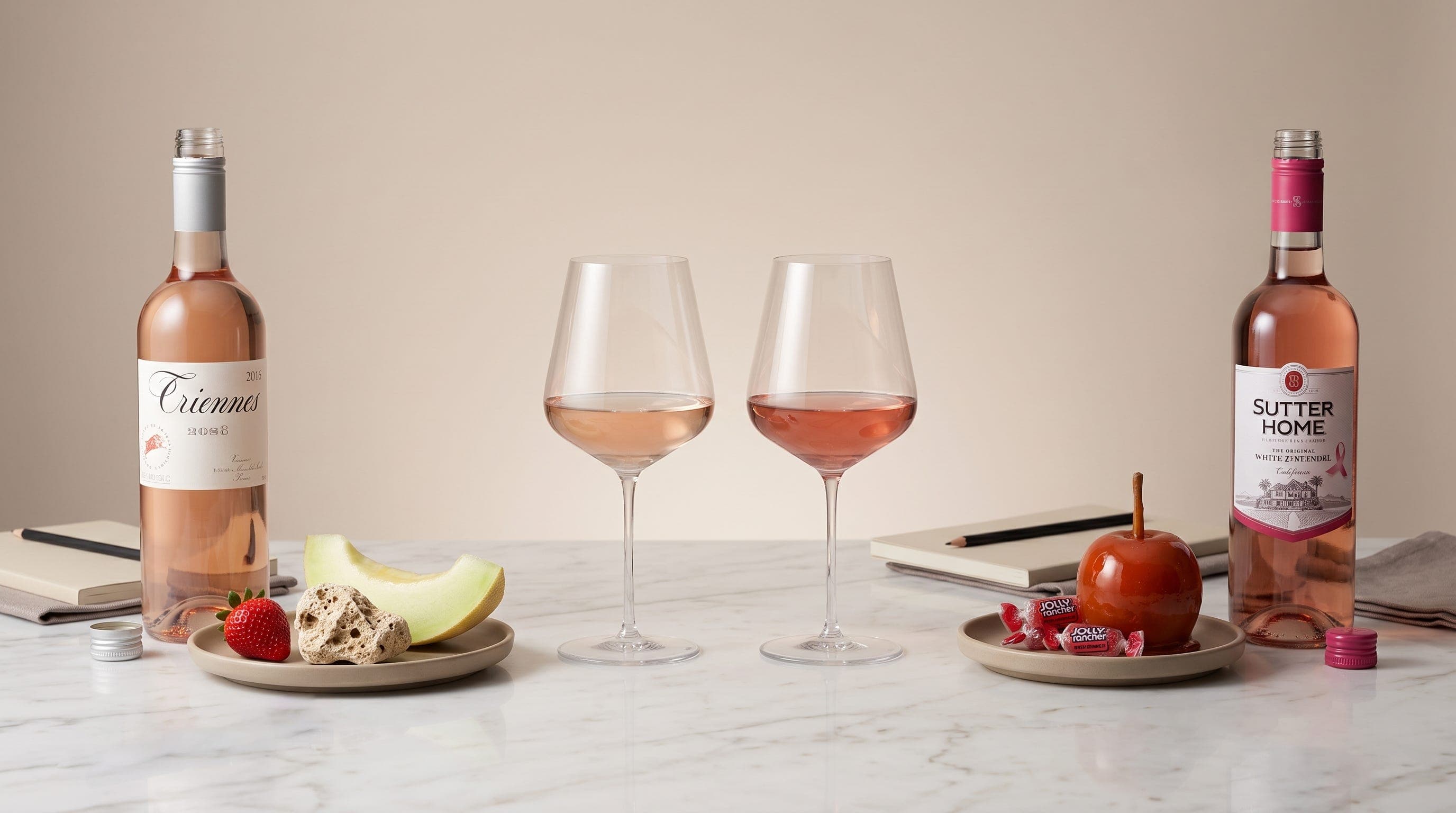
#2: Dry Rosé vs Pink Sweet Rosé
Objective: Break the most common color-based assumption in all of wine, that pink means sweet.
What to try: A bone-dry Provence rosé such as Whispering Angel (Château d’Esclans), Château Miraval, or Triennes “Rosé,” roughly $18 to $25. Then a deliberately off-dry pink such as Beringer White Zinfandel or Sutter Home White Zinfandel, roughly $6 to $9.
What to notice: The Provence rosé smells of strawberry and melon and tastes bracingly dry, all acid and chalky stone. The White Zinfandel smells of candied strawberry and delivers obvious sugar on the palate. Two pink wines, opposite sugar levels, and the only honest way to tell them apart was to put them in your mouth.
Lesson: Color predicts nothing about sweetness. Pink is not a sugar reading.
#3: Fruit-Forward Dry Red vs Secretly Sweet Red
Objective: Catch the trap where it actually hides. Not in an obvious dessert wine, but in a popular red blend that sits in the dry aisle, says nothing about sugar, and quietly carries grams of it.
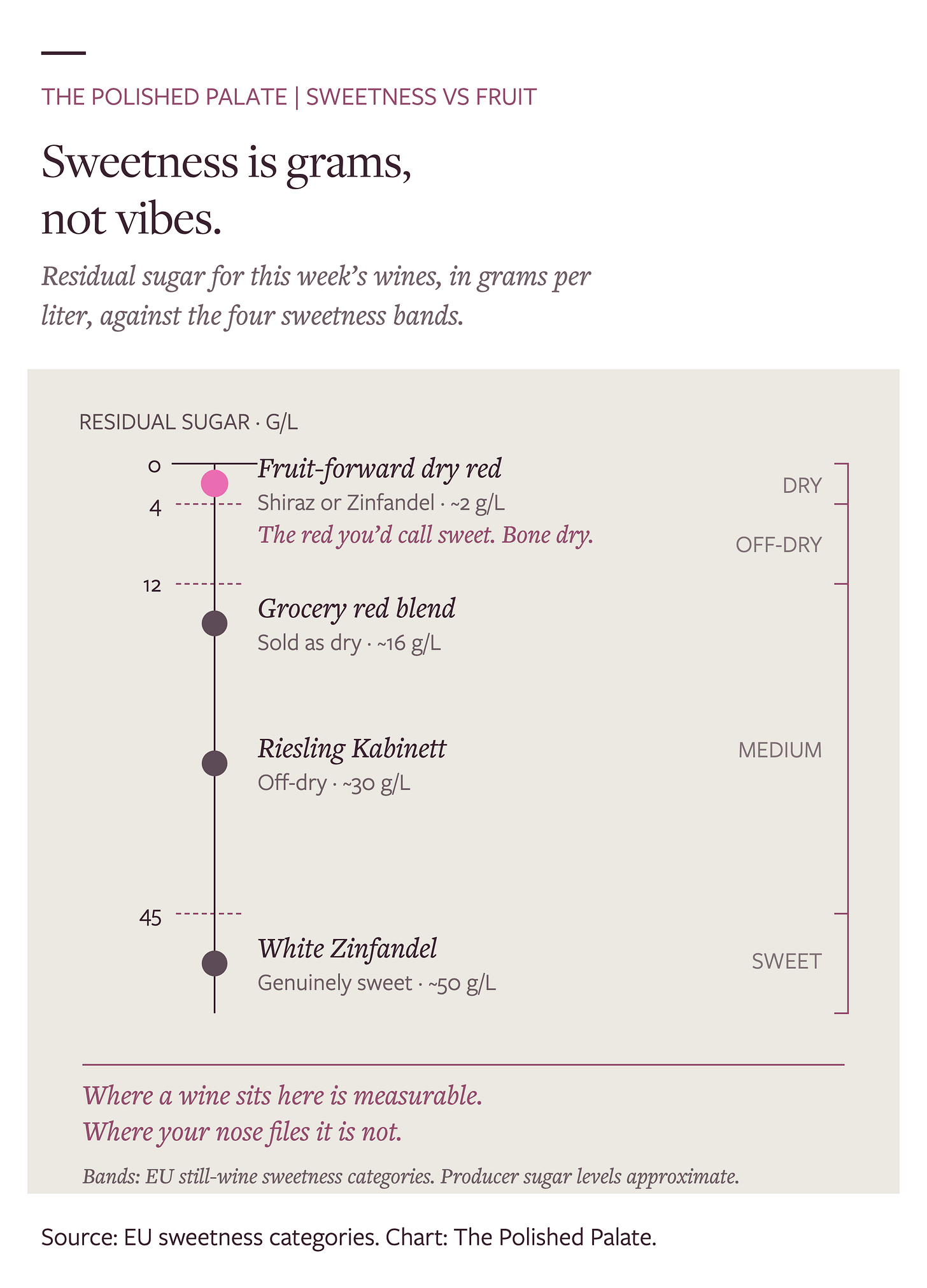
What to try: A big, fruit-forward dry red such as d’Arenberg “The Footbolt” Shiraz (McLaren Vale), Cline Zinfandel (Lodi), or Ravenswood “Vintners Blend” Zinfandel, roughly $14 to $22. Then a commercial red blend that tastes sweet but never admits it, such as Apothic Red, Ménage à Trois Red, or 19 Crimes Red Blend, roughly $10 to $14. Both sit in the dry-red section. Only one belongs there.
What to notice: The Shiraz floods your nose with jammy blackberry and vanilla, runs warm with alcohol, and feels almost plush. Many drinkers stop there and call it sweet. Hold it to the finish and it dries out, the sugar simply is not there. Now the blend. It smells just as ripe, maybe riper, and nothing on the label warns you. But swallow and wait. A soft sugary cushion settles on the tip of your tongue and the finish lingers sweet, because there really is residual sugar in the glass, often a dozen grams a liter or more. Same shelf, same price, opposite finish.
Lesson: The dry red only mimicked sweetness with ripeness and oak. The blend that never mentioned sugar was the one carrying it. The label and the price tag told you nothing. The finish told you everything.
The Finish
The reason this matters has nothing to do with passing a test and everything to do with trusting yourself. Most people build their wine identity on a sentence they inherited, “I like dry wines” or “I can’t stand sweet ones,” and then spend years rejecting bottles they would have loved because the words and the sensations never got sorted out.
When you can tell sugar from fruit, you stop arguing with labels and start describing what you actually feel. That is the core of The Resonance Method, noticing the real sensation before you reach for the borrowed name.
So here is the one thing to carry out of this week. The next time a wine strikes you as sweet, swallow, count to five, and ask whether the sweetness is still sitting on your tongue or whether it left with the smell. If it left, you were tasting fruit. Your palate was right the whole time. It was only the word that needed correcting.
Go Deeper
If this week’s idea stuck with you, these take it further.
- Dr. Vinny, “When someone asks for a fruity wine, do they mean sweet?” (Wine Spectator, 2023): A plain-language answer to this week’s exact question: why a wine bursting with ripe fruit can still finish bone dry, and how to tell on the palate.
- Gordon M. Shepherd, Neuroenology: How the Brain Creates the Taste of Wine (Columbia University Press, 2016): Shepherd, a Yale neuroscientist, explains why so much of what we call “taste” is actually built in the brain from smell, which is exactly why ripe fruit aromas get misfiled as sweetness.
- Linda Bartoshuk, “Comparing Sensory Experiences Across Individuals” (Chemical Senses, 2000): The foundational research on how differently people perceive sweetness and why “I don’t like sweet wine” means different things to different palates.