Think about the last bottle you paid real money for. The label named a place: a country at minimum, probably a region, maybe a single village or a fenced patch of hillside. You cannot taste a map, and you were never going to fly there and check the rows yourself. You paid on faith that the ground named on the label is the ground in your glass.
In January 2010, a man put a price on exactly that faith: 1 million euros.
The letter arrived at Domaine de la Romanée-Conti (DRC) in Vosne-Romanée, Burgundy, addressed to Aubert de Villaine, the estate’s co-director. The domaine farms several of the most celebrated vineyards in France, and one of them carries its name. Romanée-Conti is a walled plot of Pinot Noir covering 4.46 acres, marked by a stone cross, owned outright by the estate. Single bottles resell for five figures. Under French appellation law, wine called Romanée-Conti can come only from those specific rows. The letter said: pay, or the vineyard will be poisoned.
The threat was specific about its target. The letter named the vineyard and set a deadline, and it arrived with proof that the writer had already been standing in the rows. Whatever else the estate could lock up, move, or insure, it could not take 4.46 acres of ground somewhere safer.
Most of us will never taste this wine, sommeliers included. The estate nearly lost something that winter, and the 1 million euros put a price on it, and you are paying for the same thing on your own shelf. Here is the documented record of the plot, and of the winter Burgundy spent catching him.
While you read: a village Vosne-Romanée if you can find one (Bruno Clavelier and Anne Gros both make honest examples), or any Pinot Noir whose label names a single village.
Two letters and a map
The first package reached de Villaine in early January 2010: a hand-drawn map of the 4.46-acre plot, accurate enough to navigate by, with two circles marked on it, and a note telling him to wait for instructions.
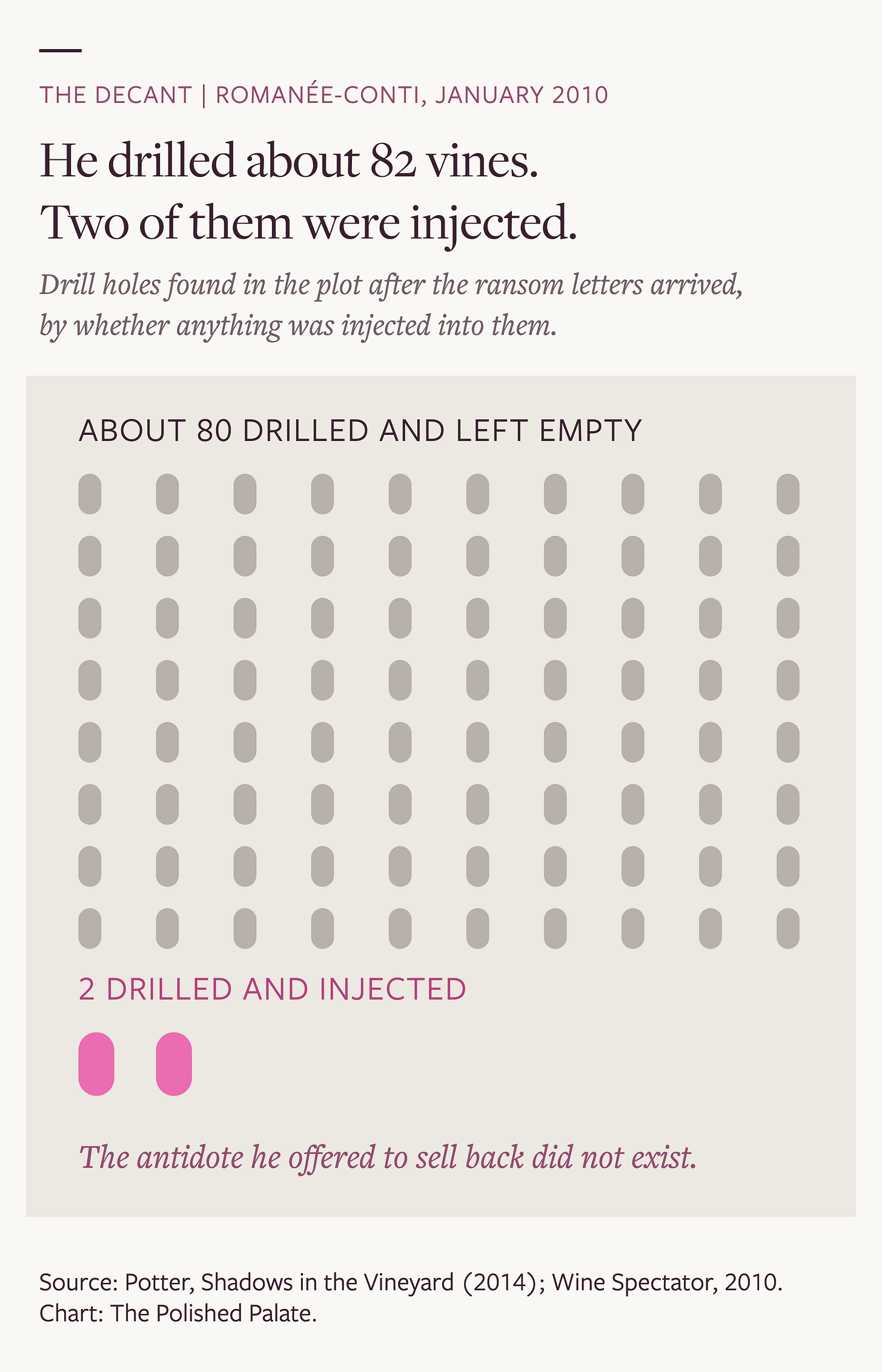
A second letter followed with the demand: 1 million euros, or the vineyard. The writer claimed the two circled vines were already dead by poison, and that some 80 more had been injected and could still be saved with an antidote he would hand over once the money was paid. A drop date in early February was set.
De Villaine contacted the police immediately. He also learned he had company. In Chambolle-Musigny, two villages north, Domaine Comte Georges de Vogüé had received nearly identical letters, complete with a detailed map of its parcels in Musigny, the grand cru that anchors that village. The demand there was smaller, a few hundred thousand euros. At Musigny, one marked vine was pulled immediately for examination. Whoever was writing had studied two of the greatest vineyards in Burgundy closely enough to sketch them by hand.
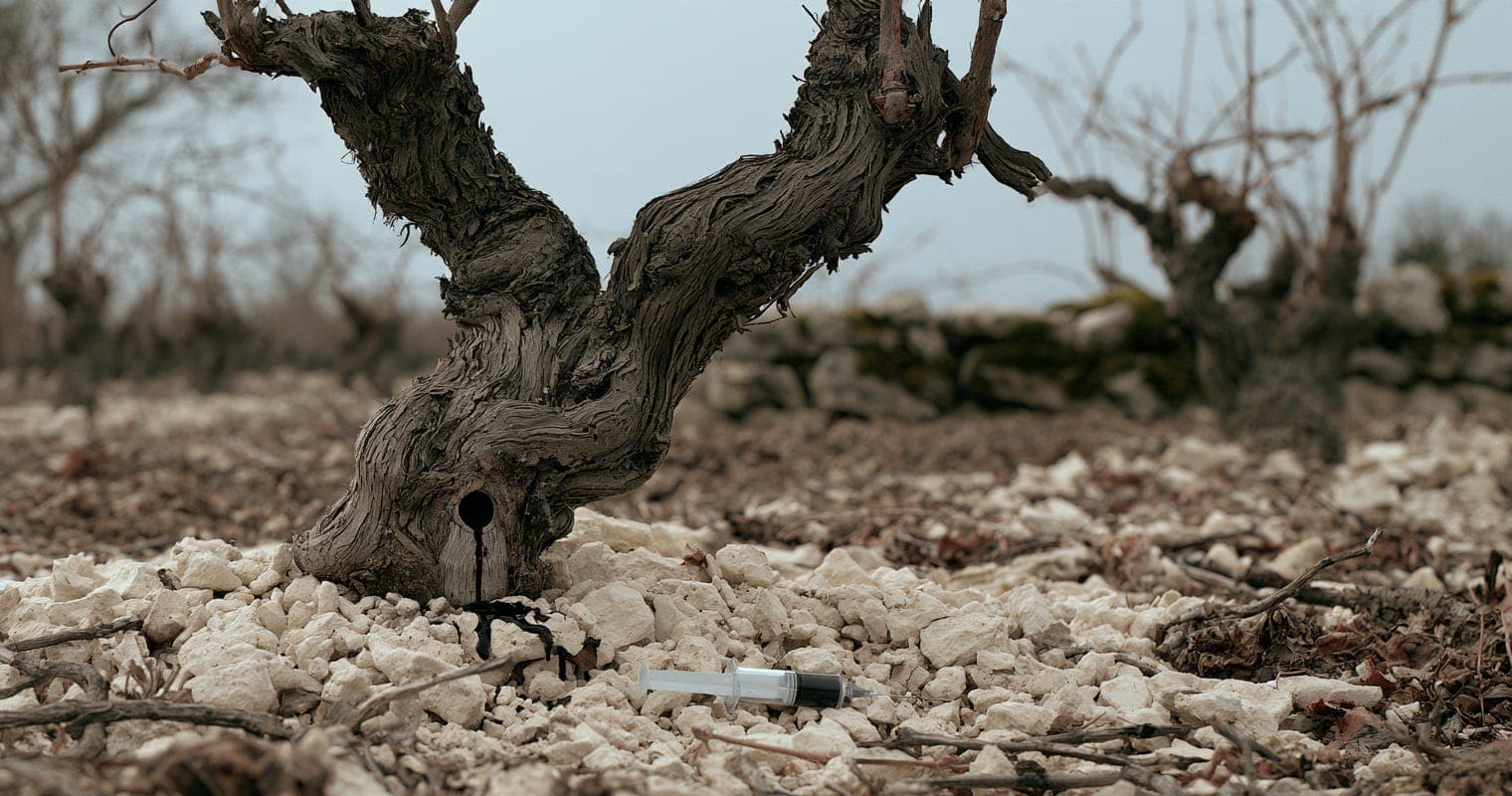
The circled vines confirmed the threat was serious. At the foot of each one, at the exact juncture where trunk meets earth, someone had drilled a small hole and injected something with a syringe. Identifying that something took years.
In May 2010, four months on, the police had still not named the substance; de Villaine told Wine Spectator that the treated vine at Romanée-Conti looked healthy, and at de Vogüé, which had also been told two of its vines were treated, the vine pulled for examination was developing poorly. Potter, writing four years later with the case closed, reports the vines were killed with herbicide, and the bottles of Roundup found in the dugout point the same way.
Crews checking the surrounding rows then found roughly 80 more vines carrying the same drill holes with nothing injected into them. The antidote he offered to sell back was a bluff, staged vine by vine, at night, with a real drill, inside Romanée-Conti itself.
The man in the hole
Sometime in the fall of 2009, months before the first letter, someone had dug a room into the wooded rise at the edge of the vineyard. Six feet deep, roughly eight feet by ten, framed with branches, roofed with tarps, camouflaged with earth and leaves. When police flew a helicopter over the woods during the investigation, they missed it.
He worked from it in the dark. Over a series of nighttime trips into the vineyard that fall, he drilled small holes in the trunks of a few vines and threaded a length of black wire into each one. The wire was harmless; it existed so that, months later, his letters could point to physical proof that he had stood among the vines and could return whenever he wanted.
Inside the dugout, investigators eventually found what he had moved in: a hot plate, a couch, the clothes of a vineyard worker, a drill, syringes, bottles of Roundup, and a handgun.
The man who dug it was Jacques Soltys, 57 years old. He grew up in Champagne, in a family that worked vines, and was sent as a teenager to study winemaking, spending two years at wine school in Beaune, in the heart of Burgundy. The rest of his adult life ran in another direction entirely: armed robbery, a kidnapping, long stretches of prison. Police described a career criminal from the Marne who had once worked Burgundy vineyards.
The record establishes where the holes went: precisely at the juncture of trunk and soil, the point at which a vine is most easily killed. Whether two years in Beaune put that in his hands, or whether anyone with a drill and a bottle of herbicide would have found the same spot, nobody ever determined.
His son Cédric, in his mid-twenties, worked with him. He had scouted de Villaine’s home address and helped mail the letters.
A suitcase at the cemetery gates
The first arranged drop came and went. The blackmailer then set a new time and place: the gates of the cemetery in Chambolle-Musigny, the same village whose Musigny vines he was threatening in his other letters.
On February 22, 2010, Jean-Charles Cuvelier, the domaine’s estate manager, carried a suitcase to the cemetery and left it. Inside was 1 million euros in fake notes and a tracking device. Out of sight around the village waited about a dozen armed officers.
The bag was picked up by a man strolling through the grounds. When it passed back out through the cemetery gateway, the tracker confirmed the movement and the police closed in. Jacques and Cédric Soltys were arrested at the scene.
The death and the trial
Both men were charged with extortion in the two cases. That summer, five months after the arrest, Jacques Soltys was found hanged in the toilets adjoining his cell in a Dijon prison, still awaiting trial. He was 57. De Villaine, asked about the death of the man who had threatened his estate’s existence, said the news brought him sadness.
Cédric Soltys stood trial alone, as an accomplice. He was convicted and served a sentence measured in months.
The arrests brought the story into the open, and Vanity Fair sent the journalist Maximillian Potter to Burgundy to cover it. His reporting grew into the 2014 book Shadows in the Vineyard, still the fullest account of the case.
At the domaine, the two drilled vines were pulled out and destroyed, and the estate went back to work. What stayed with de Villaine, and what he said out loud to the wine press, was the idea itself: now that one man had shown the way, every great vineyard in the world was open to the same threat.
What the ransom actually priced
Nobody recorded what Soltys thought he was doing. He left ransom notes and no rationale, and he died before a court could ask him. What is on the record is the behavior of everyone else.
Run down the estate’s assets. A cellar full of finished wine can be stolen, and wine cellars are robbed every year; insurers write policies for exactly that. A label can be counterfeited; in August we covered Austria’s 1985 antifreeze scandal, where the sweetness in the bottle itself was counterfeit and the fraud ran for years before a lab caught it. Those crimes attack the product, and the product renews itself every harvest.
The vineyard carries the whole structure. Appellation law defines Romanée-Conti as that plot and nothing else; wine grown anywhere else, even from cuttings of the same vines, legally and commercially ceases to be Romanée-Conti. The five-figure price of a bottle rests on 4.46 acres of ground being alive and being itself.
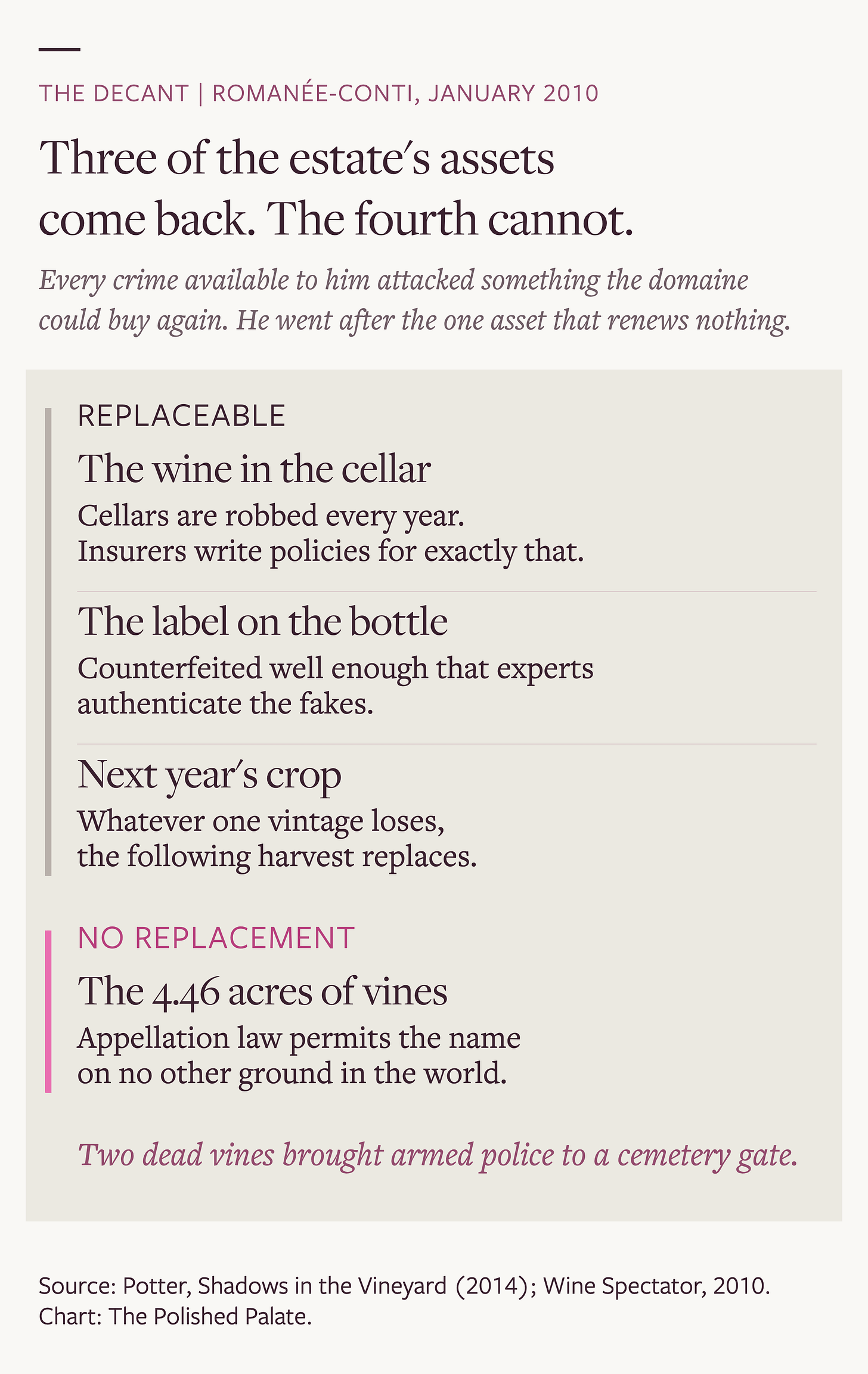
That is why two dead vines were enough to bring armed police to a village cemetery in winter. The domaine packed a suitcase of counterfeit notes, the police committed a dozen armed officers to a graveyard in February, and nobody in either group needed the point argued to them.
There is an honest objection to make here. Part of that irreplaceability is paperwork. Appellation law is a human decision about where a name may be used, and it could be redrawn; the same Pinot Noir cuttings in the same limestone one commune over would still make wine, and that wine would taste like something in its own right. So part of what the estate owns is a rule, and rules are decisions that people made and could unmake.
The rule still has to sit on top of something physical. Every mechanism the estate has for defending its name, the appellation, the bottling, the price, works only while those vines are alive, and a drill can kill them.
Sixteen years on, the estate’s standing is intact; when Michelin published its first Grape Selection this summer, Domaine de la Romanée-Conti was one of nine Burgundy estates awarded 3 grapes, the guide’s top rating.
Now bring this down to your own shelf. You most likely do not shop in this realm, and neither do I. Every honest bottle is priced on a version of the same logic.
Put a $55 Pinot Noir from a named village next to a $20 Pinot Noir blended from nowhere in particular. Thirty-five dollars separates them, and several things are in that gap: lower yields, hand work, better barrels, a slower cellar, somebody’s marketing budget. Only one of those is printed on the front of the bottle, and it is the one you are asked to pay for by name.
So origin is the claim worth checking. You cannot audit the farming from your kitchen and you will never see the yields, and the wine in the glass is the only evidence of the place you will likely ever hold. The same is true at $25 and at five figures.
If you sell wine for a living, you stand on the other side of this transaction several times a night. You put a village wine in front of a guest, you tell them it tastes like where it came from, and your own credibility covers the distance between the name on the label and the liquid in the glass.
Tasting attentively is the check you can run yourself. Learning to notice when a wine tastes specific, like it could only have come from one kind of place, one climate, one picking decision, is how you find out whether the extra money for a named place bought you anything. It also teaches you what it feels like when it did not.
Pocket Palate: the Romanée-Conti ransom
One card to save from this story.
- The demand: 1 million euros, in letters sent to Aubert de Villaine in January 2010, with a hand-drawn map of the vineyard.
- The proof: 2 vines drilled at the base and injected. Potter reports they died; the Romanée-Conti vine still looked healthy four months on. Roughly 80 more were drilled with nothing in them, so the promised antidote was a bluff.
- The arrest: February 22, 2010, at the cemetery gates of Chambolle-Musigny, over a suitcase of fake euros with a tracker inside.
- The man: Jacques Soltys, 57, wine-school trained, with a record of armed robbery and kidnapping. He died in custody before trial; his son was convicted and served months.
- The point: the ransom priced origin. Bottles and labels can be faked or replaced; the living vineyard cannot.
The Finish
The market makes this valuation every day, quietly, on every honest bottle at every price: the ground is the part with no replacement, and the place named on the label is what you are paying for. In 2010 a ransom note put a number on it, and a domaine and a dozen armed officers behaved as though the number were about right.
Take one bottle you already own whose label names a place. How much of its price is that place, and how much of the place can you actually find in the glass?
One action: this week, open one wine whose label names a single village or vineyard, taste it with attention, and write two sentences about anything in it that seems specific to somewhere. If nothing does, write that down too. Both answers tell you where your trust in a label comes from.
Go Deeper
If this week’s idea stuck with you, these take it further.
- Plot To Poison Famed French Wine Makes For Gripping (Pinot) Noir (NPR, 2014): an interview with journalist Maximillian Potter covering the hidden bunker, the sting, and de Villaine’s response to the plot.
- Simon Worrall, The Extortion Plot That Shook France’s Wine Country to Its Roots (National Geographic, 2014): an interview with Potter on the underground hideout, the drilling method, and why the helicopter search failed.
- Maximillian Potter, Shadows in the Vineyard (Twelve, 2014): the book-length account of the case, grown from Potter’s original Vanity Fair reporting; the fullest source on Soltys and the investigation.
- DRC Extortionist Threatened to Poison Musigny Vineyard Too (Wine Spectator, 2010): contemporaneous reporting on the twin threat against Domaine Comte Georges de Vogüé, with de Villaine’s first public comments.
- The Winners of the First Michelin Grape Selection in Burgundy (Michelin Guide, 2026): where the estate stands today, one of nine Burgundy producers rated 3 grapes in Michelin’s first wine selection.