You have talked yourself into a bottle. Somewhere in the last month you stood in front of a shelf, put the $14 back, picked up the $42, and told yourself something about quality that you could not have defended out loud if the person next to you had asked.
Fred Franzia would have asked. He spent fifty years asking, and he built a company selling twenty million cases a year, which by 2009 made it the fourth-largest winery in the United States.
“You tell me why someone’s bottle is worth eighty dollars and mine’s worth two dollars,” he told Dana Goodyear of The New Yorker in 2009. “Do you get forty times the pleasure from it?”
He died on September 13, 2022, at seventy-nine, at his home in Denair, California. The obituaries in the trade press were noticeably guarded, written about a man the industry had resented for decades. I want to make the uncomfortable case, because half of what he said was correct, the research supports it, and the wine world has never really answered him. The other half is answered by his own case file.
A $27,000 name
Charles Shaw was a real Napa winemaker before his name went on a $2 bottle. He founded a winery in the Napa Valley in the 1970s and wanted to make Burgundy in a place that had decided it wanted Bordeaux. Goodyear’s reporting describes the rest as the eighties Napa life in miniature: the house in the middle of the vineyard, the tennis court, the good-looking kids, the messy divorce, the bankruptcy, the winery sold on the courthouse steps. Shaw himself moved to Chicago and went to work in information technology on the night shift.
Franzia bought the brand and its trademark in 1995, during the bankruptcy proceedings, for $27,000. This was standard practice for him. He bought labels out of bankruptcy the way other people buy tools at estate sales, kept the packaging, changed the wine inside and the price, and held a couple dozen brands in reserve waiting for an opening. A Napa vintner who did business with him told Goodyear the bottles lined up on the Bronco conference room shelves felt like ghouls staring down at you.
He sat on Charles Shaw for seven years. In 2002, with a large excess of wine on the bulk market, he put it into a 750ml glass bottle with a real cork, filled it with varietal wine, and sold it through Trader Joe’s for $1.99. Outside California he had to go through a third-party wholesaler, which put it closer to $2.99.
Cheap wine had existed forever. His invention was cheap wine that a professional with a mortgage would carry to a dinner party without explaining himself, and it opened a category the industry then had to name: super-value, wine under three dollars a bottle.
One point of family bookkeeping, because it gets garbled constantly. Fred Franzia never owned the boxed wine with his family’s name on it. His grandfather Giuseppe emigrated from Italy in 1893, his grandmother Teresa started the commercial winery after Prohibition, and the family sold Franzia Brothers to Coca-Cola in 1973.
Fred was furious about it. “My dad, he was not a fighter,” he told Goodyear. “He just folded. And he and I went through a period of no communication, I think for five years. I just was pissed.” He refused to work for Coca-Cola and founded Bronco Wine Company that same year with his brother Joseph and his cousin John. Charles Shaw is a Bronco brand. The box in the supermarket belongs to a different company entirely.
Take that and shove it, Napa
By 2009 Bronco had sold its four-hundred-millionth bottle of Charles Shaw. Franzia’s comment on the milestone, quoted by Goodyear: “Take that and shove it, Napa. Four hundred million and climbing.”
The grudge was structural and he was explicit about it. The Mondavis, he liked to point out, were “the original carpetbaggers,” a Central Valley grape-shipping family who did not own a Napa vineyard until 1943. “Bob Mondavi’s objective was to forget he was poor,” he told Goodyear. “That’s the essence of the San Joaquin Valley versus the Napa Valley right there. We are who we are. They want to pretend they’re royalty. Bullshit. We’re all the same.”
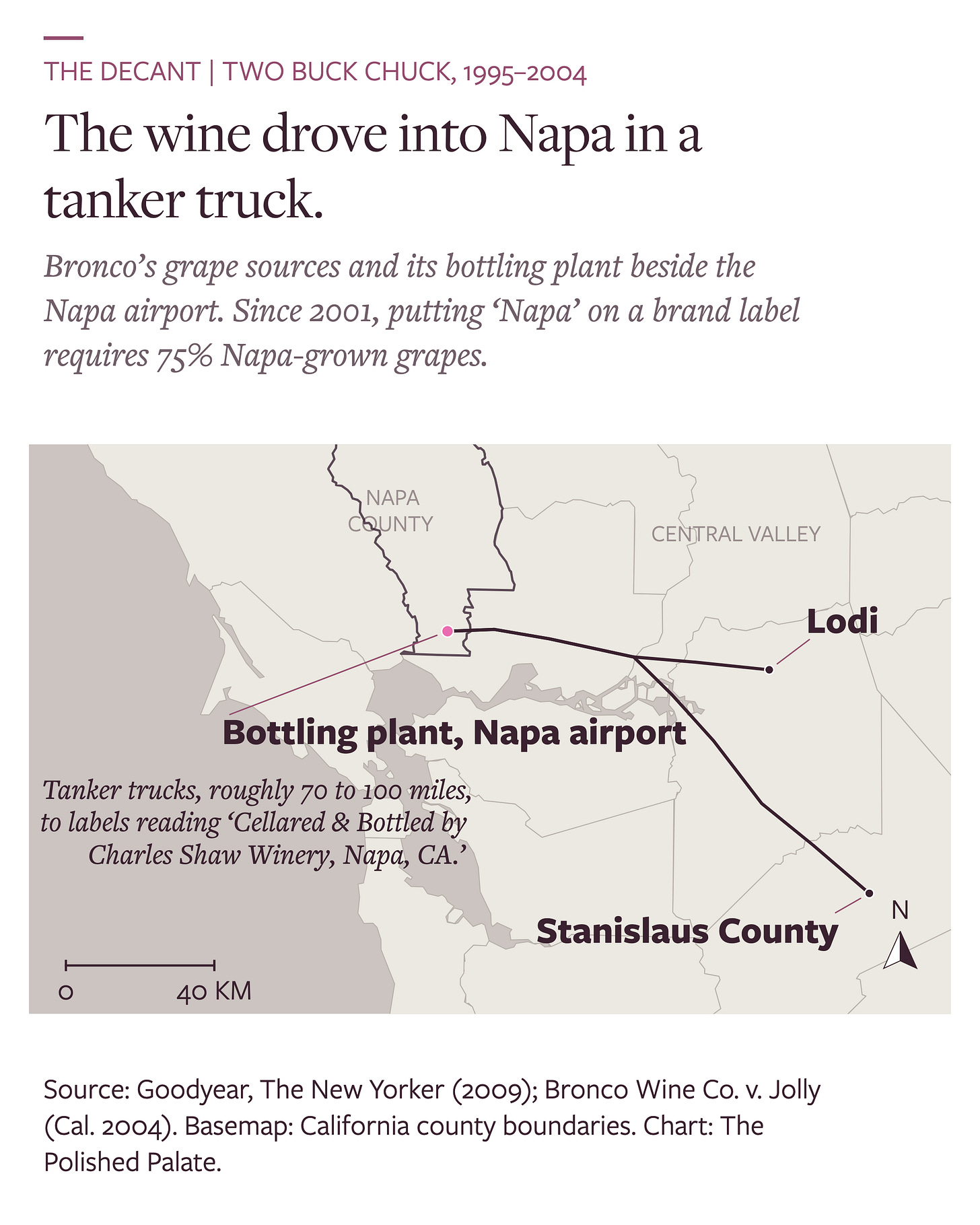
He spent roughly $40 million buying the Napa Ridge trademark, and picked up Napa Creek and Domaine Napa as well, exploiting a loophole that let brands established before 1986 keep a “geographically misdescriptive” name. He filled them with grapes from Lodi and Stanislaus County. In 2000 he opened a 92,000-square-foot bottling plant near the Napa airport with three high-speed lines, one dedicated to Charles Shaw. Wine trucked up from the Central Valley in tankers could then be labeled “Cellared & Bottled by Charles Shaw Winery, Napa, CA.” Vic Motto, an adviser to Napa wineries, gave Goodyear the industry’s term for it: a Zip Code winery.
Napa Valley Vintners got the loophole closed by statute, effective January 1, 2001. Over that Christmas holiday, Franzia sued the State of California.
The case ran five years. On August 5, 2004, the California Supreme Court ruled against him, holding that federal labeling law did not preempt the state statute requiring that at least 75 percent of the grapes be grown in Napa County before the word “Napa” appears on a brand label. The opinion accounts for it flatly: three brands, Napa Ridge, Napa Creek Winery and Rutherford Vintners, on wine made from grapes grown, in the court’s words, “in areas far from Napa, such as Stanislaus County and the environs of the City of Lodi,” where the cost of the fruit and often its perceived quality are considerably lower. The court also noted that the Napa bottling plant could produce roughly 18 million cases a year, more than double the entire annual production of Napa-grown wine. The United States Supreme Court declined to take the case in March 2005, and the litigation closed in January 2006.
His response was to release a wine made from actual Napa grapes under the Napa Creek label at $3.99 and call it Four Buck Fred.
The half he got right
Start with the arithmetic he was pointing at, because it is not in dispute.
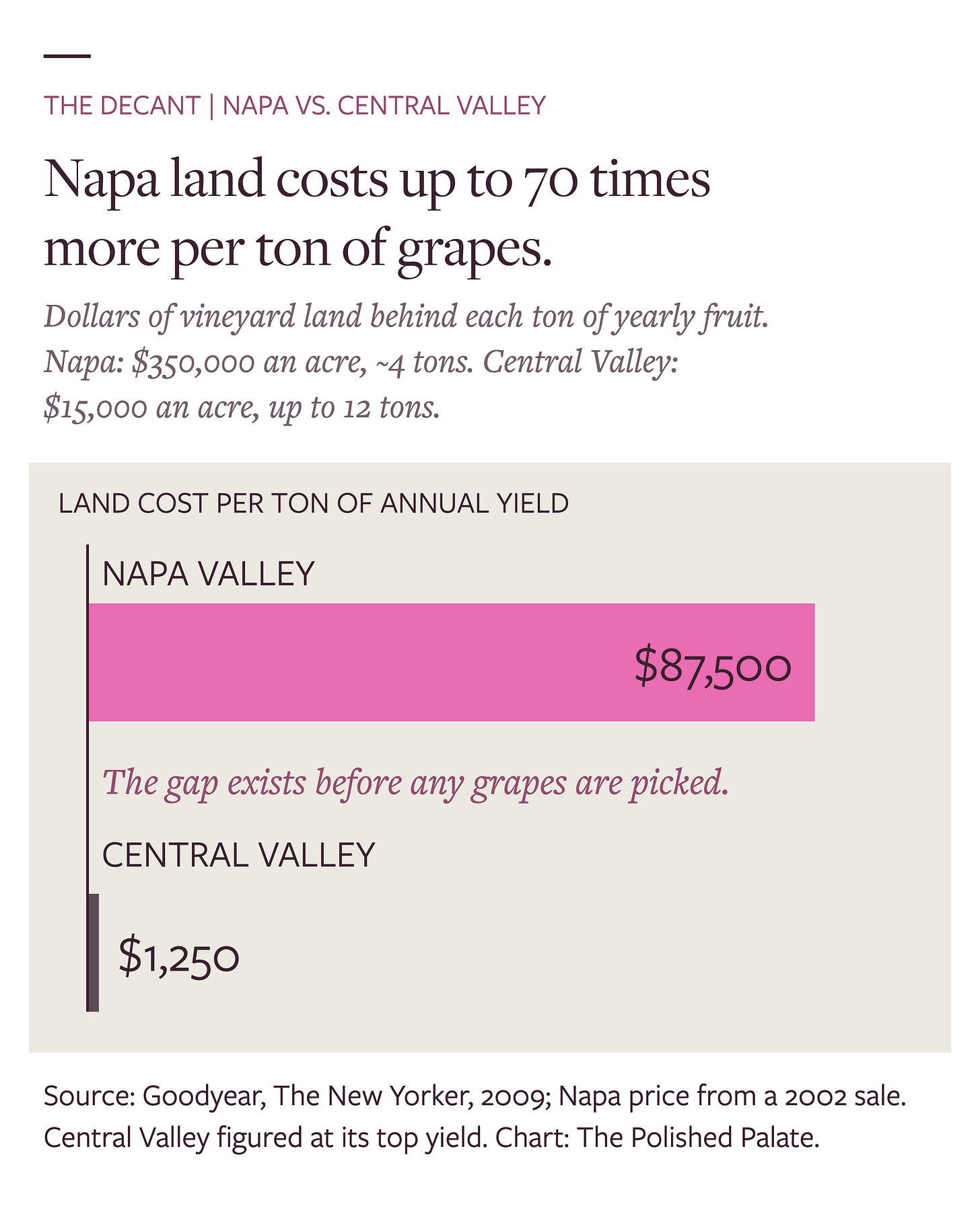
Central Valley farmland ran around $15,000 an acre when Goodyear reported the piece, and yields there can reach twelve tons an acre. Napa yields about four tons an acre and is some of the most expensive agricultural land on earth. Francis Ford Coppola bought a Napa vineyard in 2002 for nearly $350,000 an acre. Napa produces about four percent of California’s wine by volume and commands up to ten times Central Valley prices on the bulk market. A meaningful share of what separates a $2 bottle from an $80 bottle is land cost, yield, and sixty years of marketing that raised the price of both.
Then the awkward part. In 2004 the 2002 Charles Shaw Shiraz took a double gold at the 28th Annual International Eastern Wine Competition against roughly 2,300 other wines. The 2005 Chardonnay took a double gold at the 2007 California State Fair, and James Laube, Wine Spectator’s chief California critic, described that Chardonnay as “clean and intense, with ripe, vivid citrus and pear flavors that end with a refreshing lemony edge.” Laube was not being generous elsewhere in the range: he gave the 2004 Merlot 77 points and called it thin and weedy.
Carol Emert, who covered the wine’s rise for the San Francisco Chronicle, told NPR the thing that made it a phenomenon was that “it had a different profile than cheap wine. It tasted like good wine.”
And then the research. In 2008, Robin Goldstein and five co-authors published an analysis of more than 6,000 blind tastings in the Journal of Wine Economics. Five hundred and six participants tasted flights drawn from 523 wines, double-blind, between April 2007 and February 2008. For tasters without wine training, the correlation between price and overall rating was small and negative. On average they enjoyed the more expensive wine slightly less. The finding survived the removal of the top and bottom price deciles, which strengthened it.
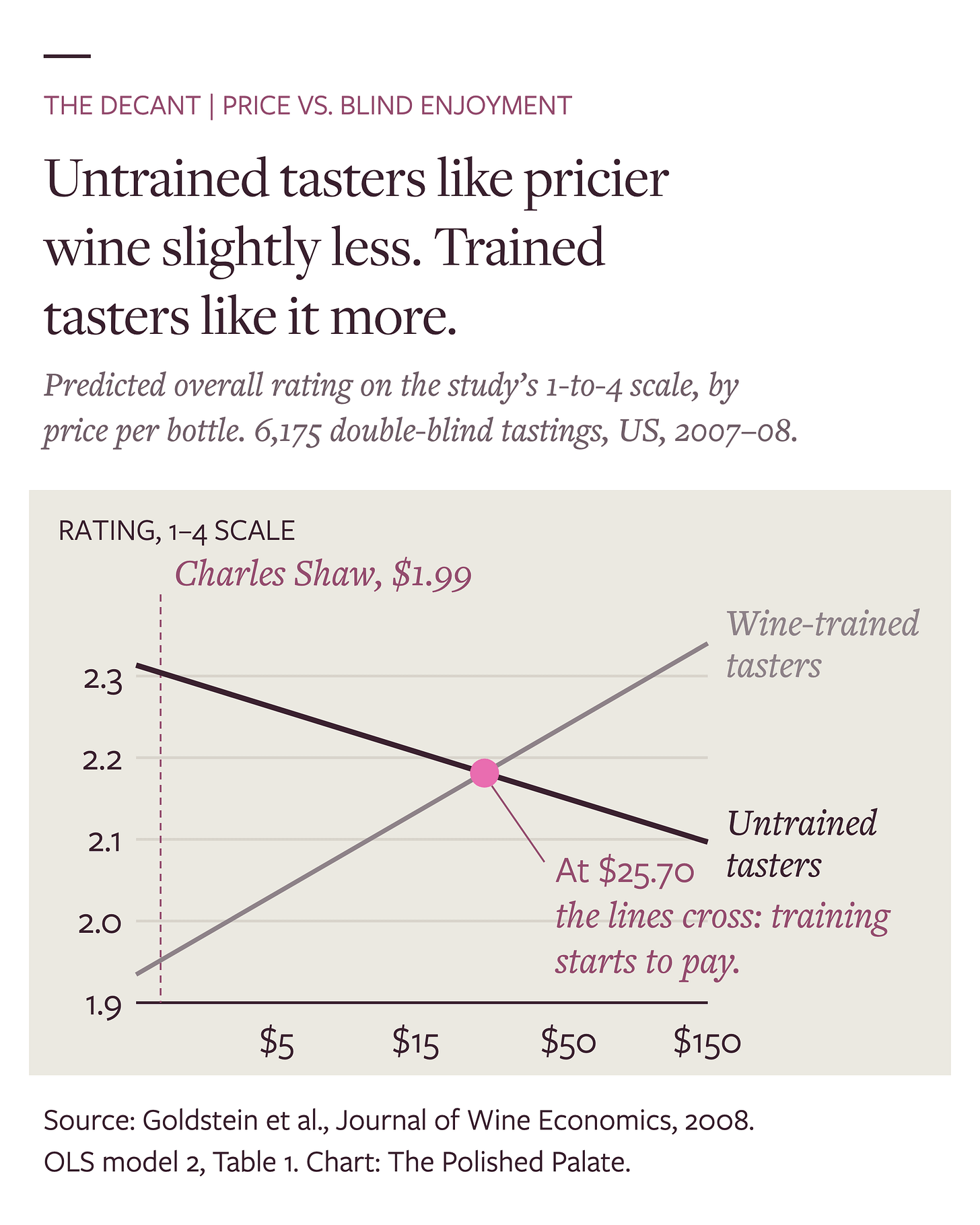
The same paper carries a qualifier the popular coverage dropped. For participants with wine training, the relationship between price and enjoyment turned non-negative. Training changes the answer.
So Franzia’s question stands up better than the trade has ever admitted. If you have not built the perceptual vocabulary, the $80 bottle very likely does not give you eighty dollars of anything, and a large part of the trade is paid to tell you it does.
The half his own file answers
In 1994 Franzia pleaded guilty to conspiracy to commit fraud with Bronco by falsely labeling grapes. He paid a $500,000 fine personally. The company pleaded no contest and paid $2.5 million. The grand jury indictment held that in the late eighties and early nineties Franzia and Bronco misrepresented about a million gallons of wine worth some five million dollars on the bulk market.
He was said to have instructed that Zinfandel leaves be scattered over cheaper grapes, a practice he called the blessing of the loads. The judge ordered him off Bronco’s board and out of the company presidency for five years; he moved into the chief financial officer’s chair and, as he put it to Goodyear, “the chairs didn’t move.” He served 500 hours of community service at a child-abuse-prevention center in Modesto under the alias Ralph Kramden, and later asked George W. Bush for a pardon, which he did not get.
The man arguing that premium prices were an invention had already been convicted of inventing one, passing off cheap grapes as Zinfandel to collect the markup himself. His grievance was that Napa got to profit from the story and he did not.
Karen MacNeil, who wrote The Wine Bible, put the consumer side of it to NPR as precisely as anyone has: “The fallacy of Two Buck Chuck is that it implied to consumers that there’s some beautiful vineyard somewhere.” That is the same misdirection as the $80 bottle with a chateau drawing on the label, at a different price point and far greater scale.
There is also a death in the record, and the facts are specific. In May 2008 a seventeen-year-old vineyard worker, Maria Isabel Vasquez Jimenez, died of heat stroke after a long day tying vines in a vineyard owned by West Coast Grape Farming, a company owned by Fred, Joseph and John Franzia. She had been hired through a labor contractor, Merced Farm Labor. The state fined that contractor a then-record $262,700 for violations including failure to provide accessible drinking water and shade.
In March 2011 the contractor’s owner pleaded guilty to a misdemeanor count of failing to provide shade, and her brother, the company’s safety coordinator, pleaded guilty to a felony count of failing to follow safety regulations resulting in death; both were barred from farm labor contracting. Franzia told Goodyear that water had been continuously available and disputed the account. The criminal findings landed on the contractor. The vineyard was his.
Pocket Palate: what you are actually paying for
Five things the record supports about the gap between a $2 bottle and an $80 one.
- Land: Napa vineyard sold for nearly $350,000 an acre in 2002; Central Valley farmland ran around $15,000 an acre in 2009.
- Yield: Napa averages about four tons an acre against as much as twelve in the Central Valley, so every Napa bottle carries more of the land cost.
- Scarcity: Napa is about four percent of California’s volume and commands up to ten times Central Valley prices on the bulk market.
- The blind-tasting result: across 6,000-plus blind tastings, untrained drinkers rated more expensive wine slightly lower on average once the price was hidden.
- Training flips it: in the same study, tasters with wine training showed a non-negative price-to-enjoyment relationship, which is the entire argument for building a palate.
The Finish
Franzia asked the right question, whether a higher price means a better wine, and then handed you his answer, that the premium is always a fiction. That is exactly what he accused Napa of doing. Napa and Franzia both wanted to decide for you what a bottle is worth, and both made money when you took their word for it.
The only version of that answer worth having comes out of your own glass, with the label covered.
So run it. This week buy the cheapest drinkable bottle of one grape you can find, Cabernet or Chardonnay, whatever your shop stocks at the bottom of the shelf, and buy a serious bottle of the same grape at three or four times the price. Have someone else pour them into identical glasses while you are out of the room. Taste both, write down what you notice before you guess, then guess.
If you cannot tell, you have learned something worth far more than the price difference, and Franzia was right about you today. Taste them again in six months, after a few dozen more bottles have gone through you with attention. The Goldstein data says the answer changes. Your job is to put in enough attentive tasting that the answer changes for you too.
Go Deeper
If this week’s idea stuck with you, these take it further.
- Wynne Davis, Fred Franzia, creator of ‘Two Buck Chuck’ and champion of affordable wine, has died (NPR, 2022): The short version of the life, with Carol Emert on why the wine tasted better than its price and Karen MacNeil on what the marketing implied.
- Dana Goodyear, Drink Up (The New Yorker, 2009): The full profile, reported from inside Bronco. Nearly every Franzia quote in circulation traces back here, along with the acreage, yield, and land-price figures.
- Bronco Wine Co. v. Jolly (Supreme Court of California, 2004): The primary document on the Napa labeling fight, including the court’s own description of where the grapes actually came from.
- Robin Goldstein, Johan Almenberg, Anna Dreber, John W. Emerson, Alexis Herschkowitsch and Jacob Katz, Do More Expensive Wines Taste Better? Evidence from a Large Sample of Blind Tastings (Journal of Wine Economics, 2008): The study itself, including the finding about trained tasters that most popular summaries leave out.