

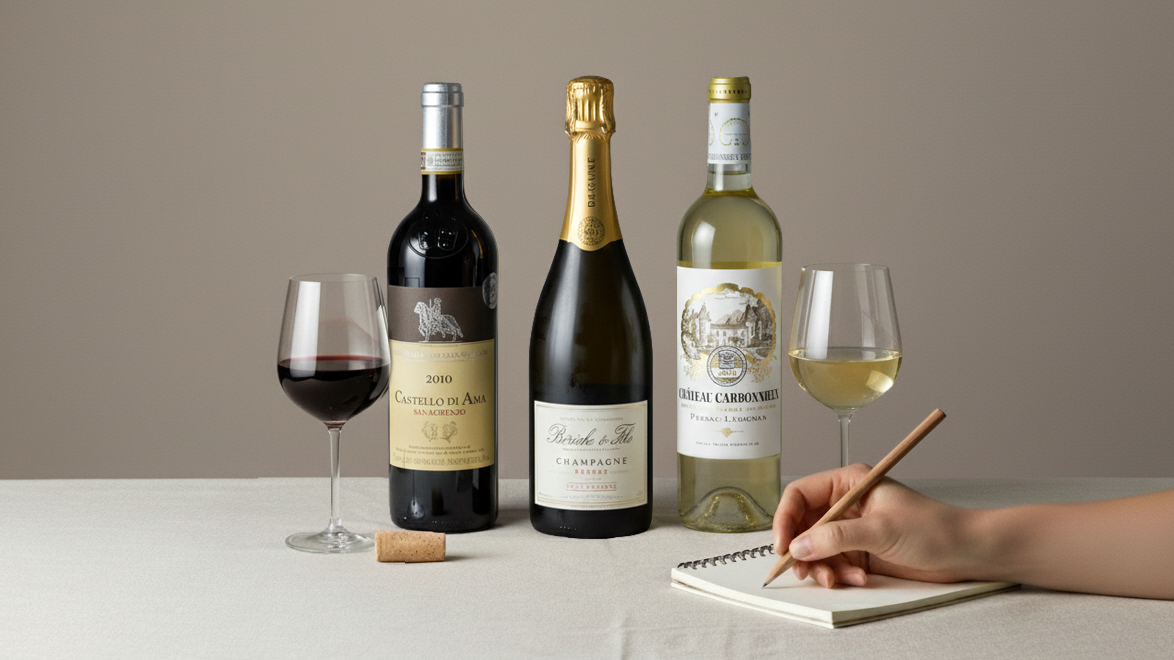
The Bottles That Built My Taste
There are certain wines that don’t just impress you — they rearrange the furniture in your mind. They stop you mid-sentence, reshape your assumptions, or pull you deeper into a world you didn’t yet know you belonged to.
When I look back on the early contours of my wine life, three bottles stand out as the ones that built my palate, shaped my preferences, and quietly defined the kind of taster I would become.
None were the flashiest or the rarest. But each carried a kind of power — the ability to change me.
1. Castello di Ama Chianti Classico — The Awakening
I was in my early 20s, having a casual dinner with two friends in New York. Jason Bateman was sitting at the next table, and we were doing our best to discreetly eavesdrop — until the wine arrived. One sip of Castello di Ama Chianti Classico interrupted everything.
I remember the juicy cherries and dried tobacco, but it was the texture that held me captive: plush, smooth, and more graceful than anything I’d tasted at that point in my life.
A wine had never stopped me in my tracks before.
In that moment, curiosity, surprise, and genuine awe took over. I didn’t know it then, but this was the beginning of my wine life.
From that night on, Chianti Classico became a constant presence in my world — a benchmark, a comfort, a companion. Years later, when I got married in Tuscany, I visited Castello di Ama for a tasting and tour. Standing there, surrounded by the very landscape that shaped that first transformative sip, I felt a pang of nostalgia and fulfillment. Chianti Classico and I had become inseparable, and it all began with that bottle.
2. Bérêche & Fils Réserve Brut — The Expansion
My second defining bottle couldn’t have been more different. I was alone in my hotel room on a work trip to New York when I opened a half-bottle of Bérêche & Fils Réserve Brut NV — a recommendation from someone at Chambers Street Wines. I wasn’t expecting much. Champagne, for me, had mostly meant standard grande marque bottlings: predictable, polished, and, if I’m honest, a little interchangeable.
But Bérêche was alive.
It had personality, tension, and all the signatures of impeccable winemaking. Autolytic depth, precision, finesse — everything in perfect proportion. This wasn’t just “good sparkling wine.” This was great wine, full stop.
The unexpected brilliance of it unlocked something in me. Champagne suddenly made sense. Not as a luxury item, but as a classic wine of creativity, identity, and expression. That one half-bottle launched me into a years-long exploration of grower Champagne, a category that has since become a cornerstone of my taste and something I’m happy that my friends associate with me. Sharing these wines — and the delight they provoke — feels like sharing a piece of myself.
3. Château Carbonnieux Blanc — The Humbling
For years, I had an active distate for oaky wines, especially Sauvignon Blanc. To me, oak meant vulgarity — vanity — a heavy-handedness that distracted from a wine’s true character. That bias held firm until a Sunday afternoon in DC, when I was working retail at Cork Wine Bar & Market.
Upstairs, a tasting group met weekly, and afterward, the leftover bottles were offered to the staff. One day I took home a Château Carbonnieux Blanc, a Grand Cru Classé de Graves — certain I wouldn’t like it but willing to taste it out of curiosity and respect for the producer.
One sip, and my dogma dissolved.
The oak wasn’t loud or showy. It wasn’t “oaky” in the way I dreaded. It was integrated — a quiet frame around the wine that made everything feel more complete. Balanced. Cohesive. A whole greater than the sum of its parts.
That bottle taught me an important lesson: assumptions are dangerous in wine. Oak can be elegant. Categories aren’t monolithic. And just like food, sometimes you don’t dislike something — you just haven’t had the right version for you.
What These Bottles Taught Me
Looking at these three wines together, I see a clear pattern: I’m drawn to classically styled wines of elegance and restraint — bottles that speak through composition, not volume. Classics are classic for a reason, and these wines, each in their own way, revealed that truth to me.
But more than that, they taught me something about the power of wine itself: it can awaken, expand, humble — deepening the experience of being alive.
My hope is that in reading this, you feel permission to find your bottles, to follow your curiosity, to rediscover wines you thought you knew, and to stay open to the unexpected.
No one’s palate is built overnight. It’s shaped bottle by bottle, moment by moment, sip by sip.
These were mine. I hope you’ll find yours.


