1 Big Idea: What Changes in the First Hour
You pull the cork at 6, leave the bottle on the counter, and pour at 7, on the theory that the wine has been breathing. Or you pour a young red into a decanter an hour ahead, because an hour of air is supposed to soften it.
An hour in a decanter does change a wine. I’ve seen it happen. The reason usually given is that air softens tannin, but Wine Spectator’s decanting guide states that the dissolved oxygen a wine picks up in an hour in a decanter does not significantly change its major components, tannin among them. The reactions that soften tannin run over months in a cellar. If the chemistry moves that slowly, what is changing in the hour that I taste?
The first candidate is evaporation, and it is fast. Maurizio Ugliano, an enologist at the University of Verona who studies oxygen in wine, puts it plainly: “Evaporation takes place instantly.” Alcohol leaves the surface, and so do the volatile sulfur compounds, the struck-match and rotten-egg notes a wine can carry out of the bottle.
A 2016 study in the Journal of Agricultural and Food Chemistry found 0.9 to 1.9 points of alcohol gone in 2 hours from uncovered glasses in the airflow of a laboratory air conditioner, along with a perceptible change in aroma. The second candidate is temperature: over an hour a wine moves toward room temperature, and it smells different at different temperatures.
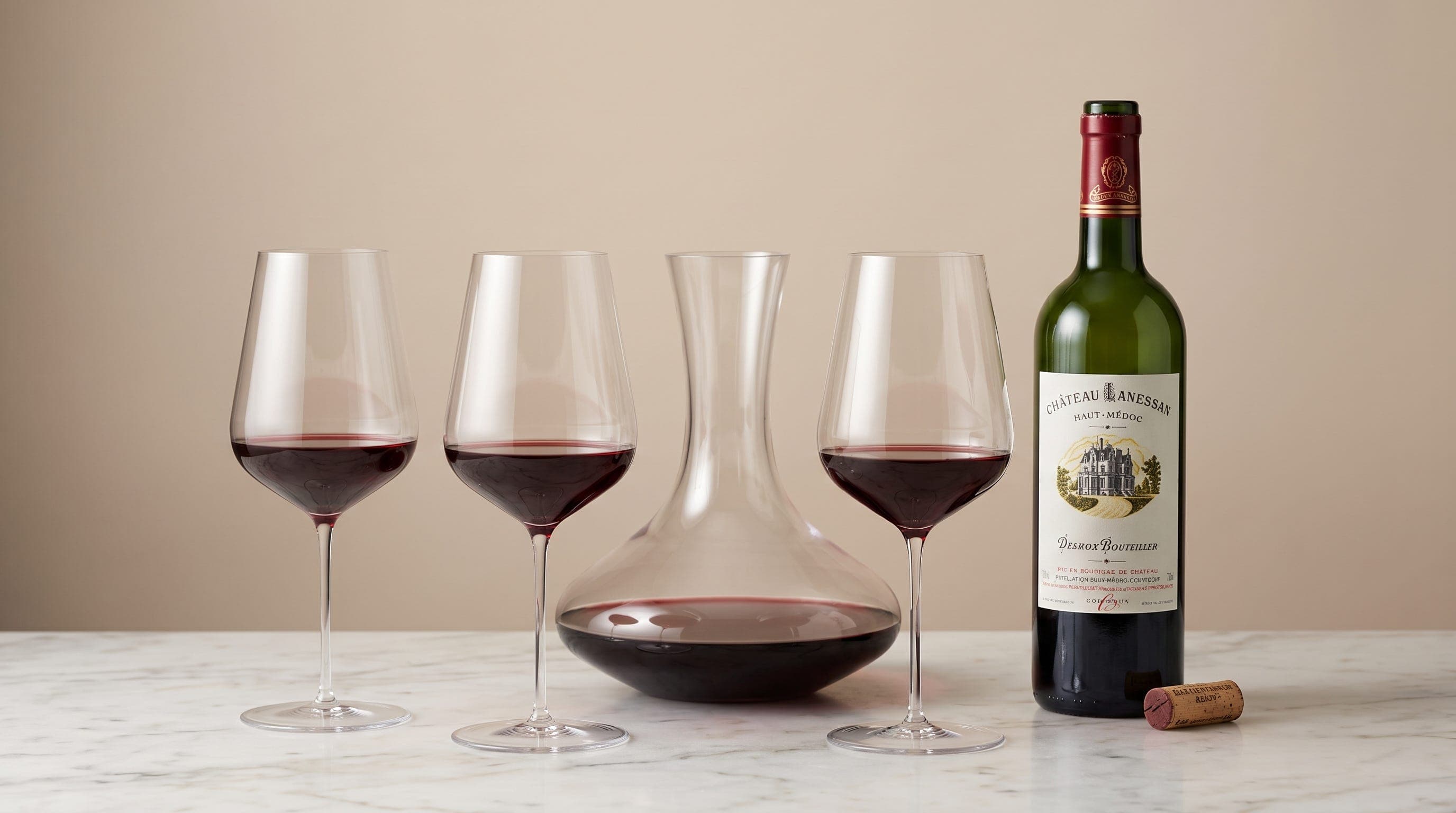
Evaporation needs surface, and surface is where a decanter and an open bottle differ most. A decanter spreads the wine into a wide pool. The opening of a standard wine bottle is about 18.5 millimeters across, a circle the size of a penny, and with the cork pulled that penny is the only place the wine touches air. Decanter magazine’s guide makes the same point: with the cork pulled, only the wine in the neck is exposed. If evaporation explains what I taste in a decanter, the open bottle should change very little in the same hour. If temperature does most of the work, both should change.
I have never run that comparison: the same wine, the same hour, half in a decanter and half left in the bottle with the cork pulled. The experiments below are how you and I find out.
3 Taste Experiments
Three separate bottles, three separate nights if you like. Each one tests a single part of what an hour of air does.
#1: A decanter vs the open bottle, same wine, same hour
- Objective: Find out whether an hour with the cork pulled changes a young red at all, compared with the same hour in a decanter.
- What to try: One bottle: Catena Malbec (Mendoza, $20-24), Château Lanessan (Haut-Médoc, recent vintage, $22-25), or Château du Cèdre Héritage (Cahors, $18-20). Taste a small glass at opening and write down 3 words. Pour half of the rest into a decanter or a wide bowl, leave the other half in the open bottle beside it, and taste a glass from each at 60 minutes.
- What to notice: Alcohol heat on the nose, any struck-match or flat, closed edge, how much fruit comes through, and the drying grip on your gums. Check each glass against your 3 words.
- Lesson: If only the decanter glass moved from your opening notes, the penny-sized opening limited how much the wine in the bottle could change, and surface is doing the work. If both moved about the same, temperature is the first suspect, since both halves sat in the same room for the same hour. If the grip differs between the two, you tasted something Wine Spectator’s guide says an hour of oxygen should not do. If neither moved, this wine showed no change from an hour of air in either vessel.
#2: The struck-match test at 0, 15, and 60 minutes
- Objective: Test the first candidate from the Big Idea: whether struck-match notes leave a wine faster when it gets more contact with air.
- What to try: A screwcap white that often opens with a struck-match note: Dog Point Sauvignon Blanc (Marlborough, $22-28), Domäne Wachau Terrassen Federspiel Grüner Veltliner (Wachau, $17-21), or Laurenz V. Singing Grüner Veltliner (Kamptal, $18-21). Pour two glasses at once. Swirl glass A hard for 10 seconds every few minutes and leave glass B still.
- What to notice: At 0, 15, and 60 minutes, rate any match-strike, flint, or cooked-vegetable note in each glass, then how loud the fruit is. Watch whether the still glass catches up with the swirled one.
- Lesson: If evaporation is doing the work, the swirled glass should clear first, because swirling keeps renewing the surface. If it does, you have tasted one thing a decanter can do in its hour. If both glasses clear at the same pace, time and temperature did the work. If the note never fades in either glass, an hour of air was not enough for this bottle.
#3: What an hour of air does to an old red
- Objective: See the other side of evaporation: whether an hour in a decanter leaves an old red with fainter aromas than it had at 5 minutes.
- What to try: Only if you have one: a red 15 years or older, decanted off its sediment. Smell a glass at 5 minutes and another at 60.
- What to notice: Which aromas from the 5-minute glass are fainter or gone at 60, and whether the acid and tannin stand out more once they fade.
- Lesson: Expect the 60-minute glass to have lost something. Aromas evaporate from the surface along with the alcohol, and an old wine’s aromas are faint, with little fruit left to cover a loss. Wine Spectator’s guide says to decant a fragile or old wine, especially one 15 years or older, only about 30 minutes before drinking. That warning is why I hesitate to decant past a certain age, though I have not watched an old wine fade in a decanter myself.
Pocket Palate: The first hour after opening
Facts from this issue, in the order you meet them.
- Tannin: Wine Spectator’s guide says an hour of dissolved oxygen does not significantly change a wine’s major components. The reactions that soften tannin run over months in a cellar.
- Evaporation: alcohol and volatile sulfur compounds leave a wide surface fast. A 2016 study measured 0.9 to 1.9 points of alcohol lost from uncovered glasses in 2 hours, in the airflow of a laboratory air conditioner.
- Temperature: over an hour, a wine moves toward room temperature, and it smells different at different temperatures.
- Decanter vs cork out: a decanter spreads the wine into a wide pool. With the cork pulled, the wine meets air through an opening about 18.5 millimeters across, the size of a penny, and Decanter magazine’s guide says only the wine in the neck is exposed.
- Old wine: Wine Spectator’s guide says to decant a fragile or old wine, especially one 15 years or older, only about 30 minutes before drinking.
The Finish
Think about the last bottle you opened early and left on the counter to breathe. Whatever you tasted an hour later, you had no second glass beside it to compare, so you could not tell what the hour had done.
One action for tonight: whatever young red you open, pour half into a decanter or a wide bowl, leave the rest in the bottle with the cork out, and taste the two side by side after an hour. A side-by-side at your own table is as good a test as any I could run.
Go Deeper
If this week’s idea stuck with you, these take it further.
- James Button, How to Let a Wine Breathe, and When (Decanter, 2025): The clearest short explainer: why pulling the cork exposes only the neck, why a swirled glass beats a counter, and why older or delicate bottles get gentler treatment.
- Dana Nigro and MaryAnn Worobiec, How to Serve Wine: Decanting 101 (Wine Spectator, 2019): The two jobs of a decanter, the 30-minute guidance for wines 15 years and older, and the plain statement that an hour of dissolved oxygen does not significantly change a wine’s major components.
- Rémy Charest, The Science Behind Decanting Wine (SevenFifty Daily, 2018): A trade-side walk through evaporation versus oxidation with Maurizio Ugliano and Jamie Goode, covering which sulfur compounds blow off and why oxidation runs on a scale of hours to days.
- David Wollan, Duc-Truc Pham and Kerry L. Wilkinson, Changes in Wine Ethanol Content Due to Evaporation from Wine Glasses and Implications for Sensory Analysis (Journal of Agricultural and Food Chemistry, 2016): The measurement behind the Big Idea: 0.9 to 1.9 points of alcohol lost from uncovered glasses in 2 hours, with drops in fermentation volatiles and a perceptible aroma change.