In 1921, a nineteen-year-old Russian officer was left for dead in the snow on a battlefield in Crimea, his cavalry unit cut down by machine-gun fire. He survived. Seventeen years later he walked into a Napa Valley winery and, over the next three and a half decades, quietly built the modern California wine industry.
His name was Andre Tchelistcheff. If you order a serious Napa Cabernet tonight, you will be tasting his work, and odds are you have never heard his name. Netflix is about to give Napa the glossy origin story television loves, all sunlight and ambition and money. The true origin story is stranger and better, and it starts with a wounded refugee who knew more about microbiology than anyone in California.
From the imperial court to a battlefield
Tchelistcheff was born in Moscow in 1901 into an aristocratic family. His father was a chief justice of the Russian imperial court. The Revolution of 1917 ended that world. From 1918 to 1921 he fought with the White Army in the Russian Civil War, and it was in the final collapse of that campaign, on the Crimean front, that he was machine-gunned and left for dead in a snowstorm. He recovered, found what was left of his family, and got out. They settled first in Yugoslavia.
A displaced aristocrat with no country had to build a usable life from nothing. He chose science. He studied agricultural technology in Czechoslovakia, then moved to France and trained at two of the most serious scientific institutions in Europe, the Institut Pasteur and the Institut National Agronomique, where he studied fermentation, microbiology, and oenology. By his late thirties he was a rigorously trained wine scientist working in Paris.
The hire that changed California
In 1938, a Napa Valley winery owner named Georges de Latour came to France looking for a winemaker. De Latour owned Beaulieu Vineyard in Rutherford, one of the few Napa producers to survive Prohibition intact, and he wanted someone with a cosmopolitan, scientific background to lift his wines.
He found Tchelistcheff at the agronomy institute and hired him. Tchelistcheff arrived in Napa Valley in September 1938 as Beaulieu’s vice president and chief winemaker.
What he found was a region making rough, inconsistent wine, decades behind Europe and freshly crippled by Prohibition. What he brought was a laboratory mind.
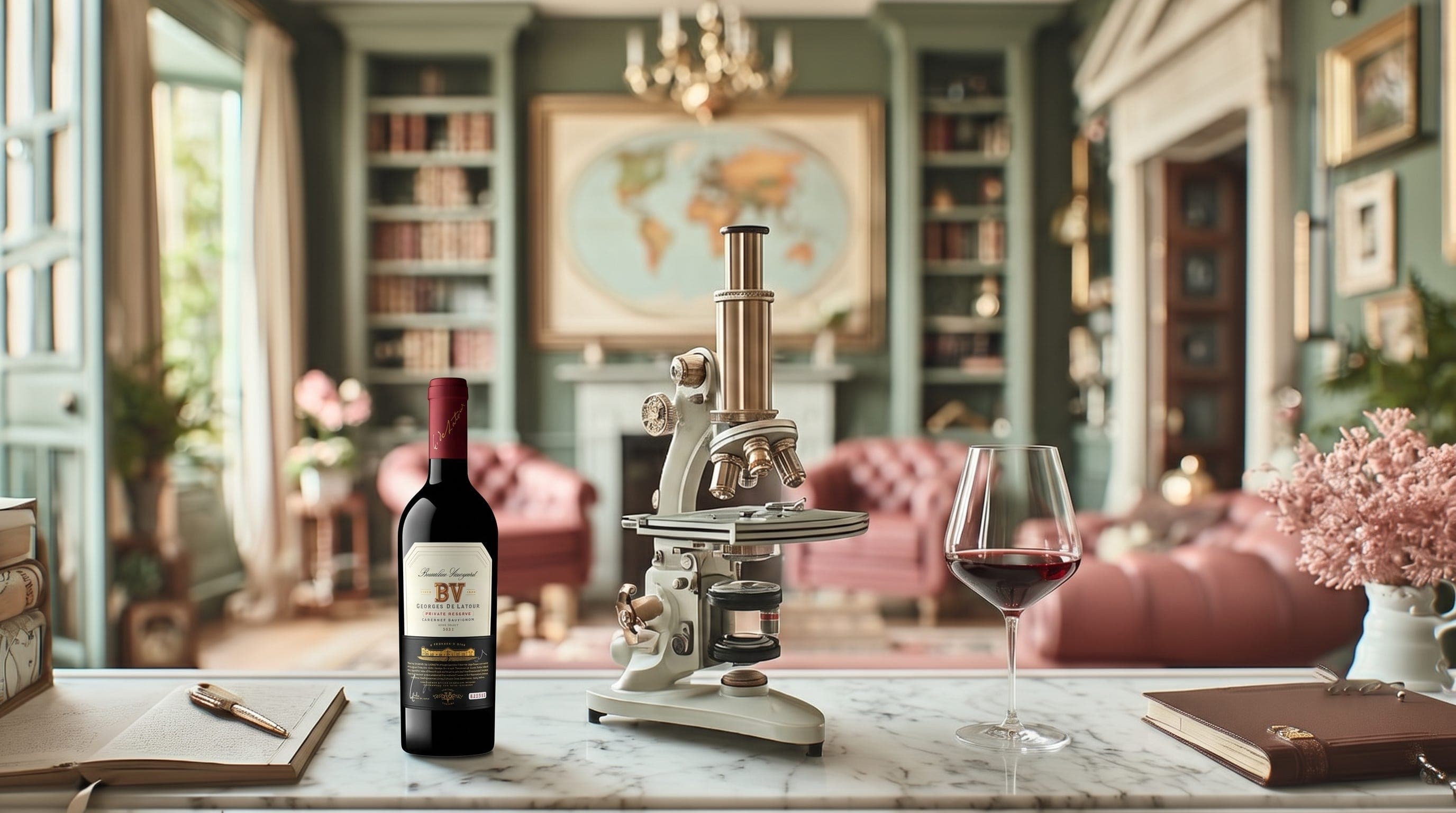
He took Beaulieu’s best Cabernet and shaped it into a single bottling, the Georges de Latour Private Reserve, and by the mid-1940s that wine was the recognized benchmark for California Cabernet, poured at White House functions. For the first time, a California red was being mentioned in the same breath as Bordeaux, on purpose, with the science to back it up.
The techniques that became the industry
The Private Reserve was the headline. The quiet revolution was everything Tchelistcheff taught the rest of the valley to do. He pioneered cold fermentation to protect the delicacy of white wines, championed malolactic fermentation to soften and stabilize reds, ran small-lot fermentations so a winemaker could understand each parcel, and worked out vineyard frost protection that saved entire vintages from being lost to a single cold night. He shared the techniques, taught them, and consulted across the valley, and they became the standard practices the entire California industry still runs on.
This is the part the trophy-bottle version of Napa leaves out. The valley became great for a reason the origin myth skips over: one trained scientist installed a working body of knowledge and then refused to hoard it.
The lineage in your glass
The clearest measure of the man is who learned from him. Mike Grgich, who made the Chateau Montelena Chardonnay that beat the French at the 1976 Judgment of Paris, came up under Tchelistcheff. So did Joe Heitz, who founded Heitz Cellars and made one of the first single-vineyard cult Cabernets in America. So, in his orbit, did Robert Mondavi, who would go on to sell Napa to the world. The people who built the modern reputation of this valley were, to a striking degree, his students.
They called him the Maestro, and later the dean of American winemakers. He stayed at Beaulieu until 1973, consulted across the valley for decades after, and died in 1994 at the age of ninety-two. By then the region he found making rustic jug wine was selling Cabernet at prices that would have been unthinkable when he arrived.
Pocket Palate: the Tchelistcheff lineage
- The source: Beaulieu Vineyard, 1938 to 1973. Cold fermentation, malolactic, small lots, frost protection. He taught all of it to the valley.
- Mike Grgich: His student. Made the Chateau Montelena Chardonnay that won the 1976 Judgment of Paris.
- Joe Heitz: His student. One of America’s first single-vineyard cult Cabernets.
- Robert Mondavi: His orbit. Sold Napa to the world.
- At the shop: Rutherford or Oakville Cabernet from a grower who farms with restraint.
- The point: The valley learned from one man.
What this is worth to you
Here is why a refugee from 1921 belongs on your radar in 2026. When Uncorked arrives and turns Napa into a backdrop for wealth and ambition, you will have the truer picture: that the quality in the glass came from European science and patient teaching. The size of anyone’s house had nothing to do with it. That knowledge is a better guide at the wine shop than any origin myth.
A bottle that descends from the Tchelistcheff school, a well-made Rutherford or Oakville Cabernet from a producer who cares about farming and restraint, will tell you more about Napa than the most expensive trophy on the list.
You do not need to memorize his name to drink well. It helps to know that the thing you are tasting in a serious Napa Cabernet, that sense of a wild place brought under control, was put there on purpose by a man who had already survived the end of his own world.
Go Deeper
If this week’s idea stuck with you, these take it further.
- Andre Tchelistcheff, The Maestro (Beaulieu Vineyard): the winery’s own account of the man who defined its wines, with the dates and the Private Reserve story.
- Andre Tchelistcheff: American Winemaker (Wine History Tours): an accessible biography that connects his techniques to the winemakers he trained.
- James O. Gump, Maestro: Andre Tchelistcheff and the Rebirth of Napa Valley (University of Nebraska Press, 2021): the scholarly biography, for readers who want the full arc from Crimea to California.