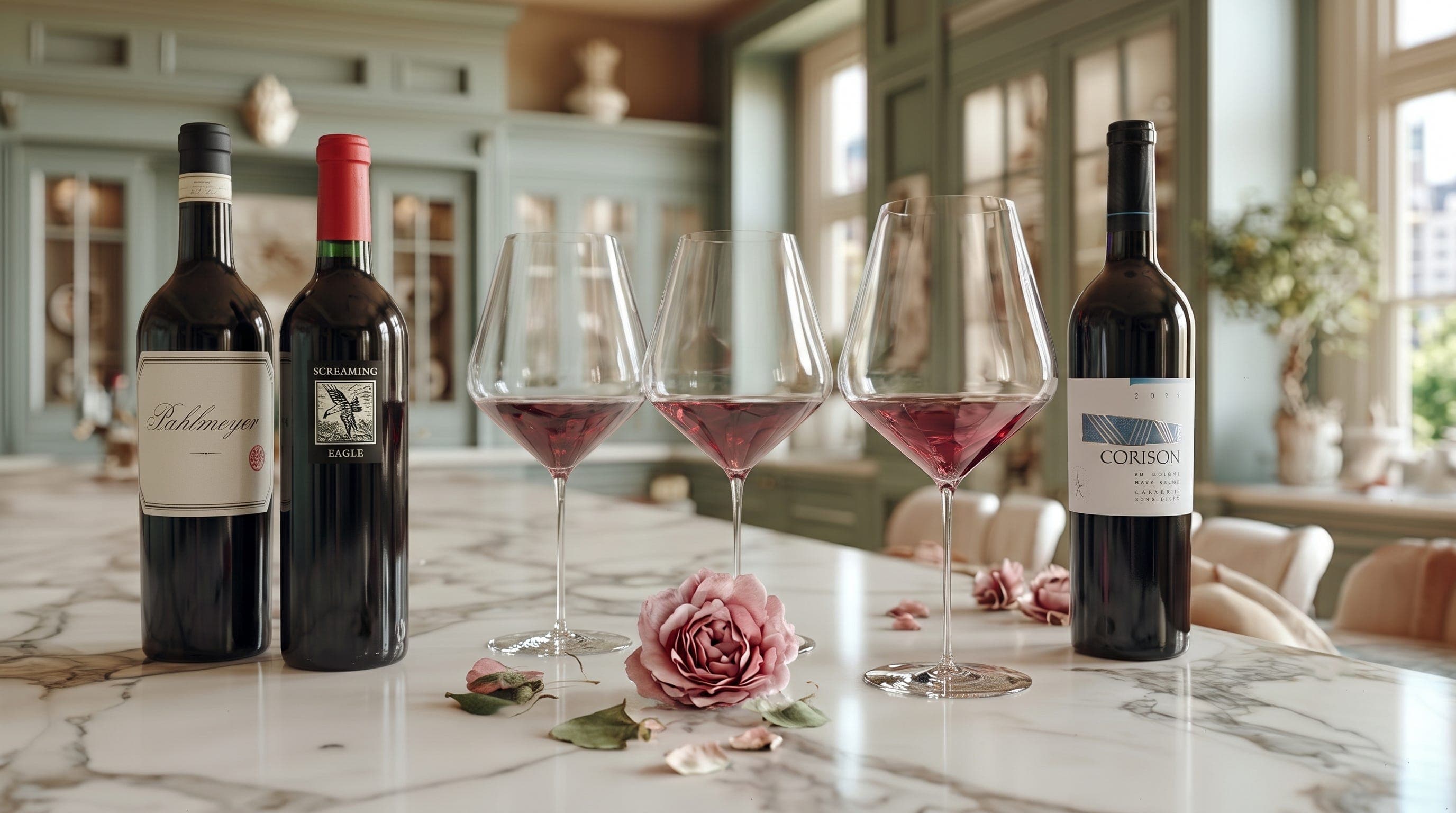
In 1992, a Napa Cabernet called Maya earned a perfect 100 points from Robert Parker, the most powerful palate in the wine world. The winemaker was a woman in her mid-thirties who had struck out on her own four years earlier. The same decade, a few miles up the valley, another woman was deliberately making the opposite kind of wine and betting her entire career that the fashion would pass.
You can probably summon the taste without the glass: dark, plush, powerful, the flavor “Napa Cabernet” has meant for thirty years. That flavor feels like a fact of nature, the inevitable taste of a sunny valley. It was a choice, argued out over the 1980s and 1990s, and the people who set its terms were largely women.
Two built the rich, lavish style that conquered the world. One held the line on elegance until the world came back to find her.
Helen Turley and the architecture of opulence
If modern Napa Cabernet has a signature, Helen Turley drafted it. Through the 1990s she became the first of the great superconsultants, the winemaker that ambitious owners hired to turn a vineyard into a legend. She consulted for Bryant Family, Colgin, Pahlmeyer, and others, and her wines shared an unmistakable style: opulent and high in alcohol, with enough polish to never feel clumsy.
Turley’s own label, Marcassin, was Chardonnay and Pinot Noir from the Sonoma Coast, and it helped put that region on the map. Her influence on Napa Cabernet came through the clients, and it was enormous.
The wines she touched earned the highest scores and the longest waiting lists, and a generation of winemakers studied what she did and copied it. The lush, powerful, point-magnet Cabernet that the rest of the world now thinks of as the Napa style was, in large part, her argument made liquid.
Heidi Barrett and the cult bottle
If Turley wrote the style, Heidi Barrett made it famous. In 1988, at thirty, she left a steady job and went out as a consultant. Her first client was Dalla Valle, where she made the 1992 Maya Cabernet that scored a perfect 100 from Parker, one of the wines that opened the entire 100-point era for California. Then came Screaming Eagle, whose first vintage she made and which became the most sought-after cult Cabernet in America. Grace Family, Paradigm, her own label La Sirena, and a long client list followed. Parker called her the first lady of wine.
Barrett’s gift was precision, the ability to take great fruit and produce a wine of flawless ripeness and polish, vintage after vintage, the kind of perfection that earns a perfect number. She did more than anyone to prove that a tiny Napa Cabernet, in the right hands, could be treated and priced like a Bordeaux first growth.
The cult bottle that I wrote about in the Screaming Eagle piece exists, in large part, because she showed it could be done.
Cathy Corison and the long bet on restraint
While Turley and Barrett were turning Napa toward power and ripeness, Cathy Corison founded her own winery in 1987 and pointed in the other direction. She made Cabernet of moderate alcohol, bright acidity, and restraint, built to age and reward patience for decades. For years this was deeply unfashionable. The market wanted size, and Corison kept making wines of elegance and length from the benchland of western Napa. Her Kronos Vineyard holds some of the oldest Cabernet vines in the valley, planted in 1971.
For a long time that looked like a losing bet. Then the wines started to age, and the case made itself. Corison’s older vintages stayed fresh and alive while many of the blockbusters grew tired, and a younger generation of drinkers and sommeliers, tired of fourteen-and-a-half percent alcohol and a wall of oak, rediscovered her.
The pendulum that swung hard toward Turley’s opulence has, in the past decade, swung back toward exactly the kind of wine Corison never stopped making.
Pocket Palate: the 3 women who rewrote Napa Cab
- Helen Turley: The architect of opulence. Bryant Family, Colgin, Pahlmeyer, Marcassin.
- Heidi Barrett: The cult perfectionist. Maya (100 points, 1992), Screaming Eagle, La Sirena.
- Cathy Corison: The long bet on restraint. Kronos Vineyard, vines from 1971. Built to age.
- At the table: Plush and powerful is Turley and Barrett. Fresh and restrained is Corison.
- The point: The house style was authored.
What this means at the table
Here is why three winemakers from forty years ago are worth paying attention to. The next time you read “Napa Cabernet” on a list and feel like you already know what you’re getting, remember that the flavor was authored, argued over, and is still contested.
You are allowed to have a side. If you love the plush, powerful style, you are drinking in the lineage of Turley and Barrett. If you reach for something fresher and more restrained, you are drinking with Corison.
Knowing the argument frees you from the marketing. A four-figure cult bottle is one answer to what Napa can be, and a hundred-dollar Corison is a different and equally serious one.
The valley that the Netflix cameras will soon flatten into a single glossy image was, in fact, built by people who disagreed profoundly about what was good. The most useful thing you can do as a drinker is figure out which of them was making wine for you.
Go Deeper
If this week’s idea stuck with you, these take it further.
- Helen Turley, Women Winemakers of California (Santa Clara University): an institutional profile of the superconsultant who engineered the opulent style, part of a university oral-history archive of California’s women winemakers.
- Our Story (Corison): Cathy Corison’s own account of choosing restraint and ageability when the market wanted the opposite, in her words.
- Heidi Barrett (La Sirena): the winemaker behind Screaming Eagle and the 100-point Dalla Valle Maya, on the craft of the cult Cabernet.