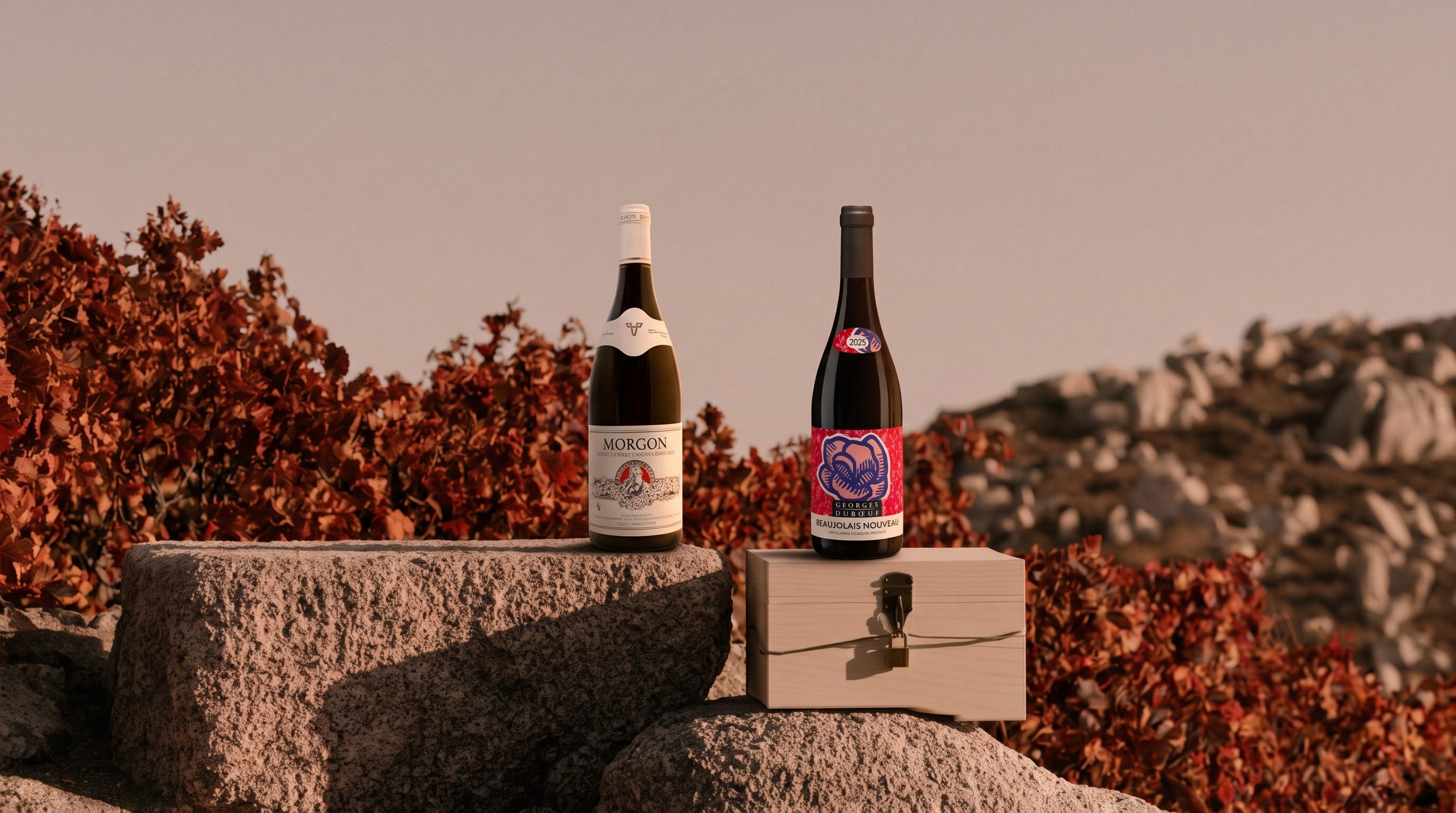
Tomorrow, the third Thursday of November, Georges Duboeuf’s Beaujolais Nouveau goes on sale again. Last November it cost about $15 at American retailers.
The day it goes on sale comes from a government exemption. In September 1951 a French order said appellation wines from that year’s harvest could not be sold before December 15. Beaujolais growers protested, and a note dated November 13, 1951, let certain wines go on sale at once. Lyon’s bars had bought new Beaujolais by the barrel since the 1800s; the note gave that custom a legal date. In 1985 a decree fixed the release at the third Thursday of November, in part because a fixed date of the 15th kept falling on weekends. The bottles now ship around the world days early and wait in locked warehouses until 12:01 a.m. local time.
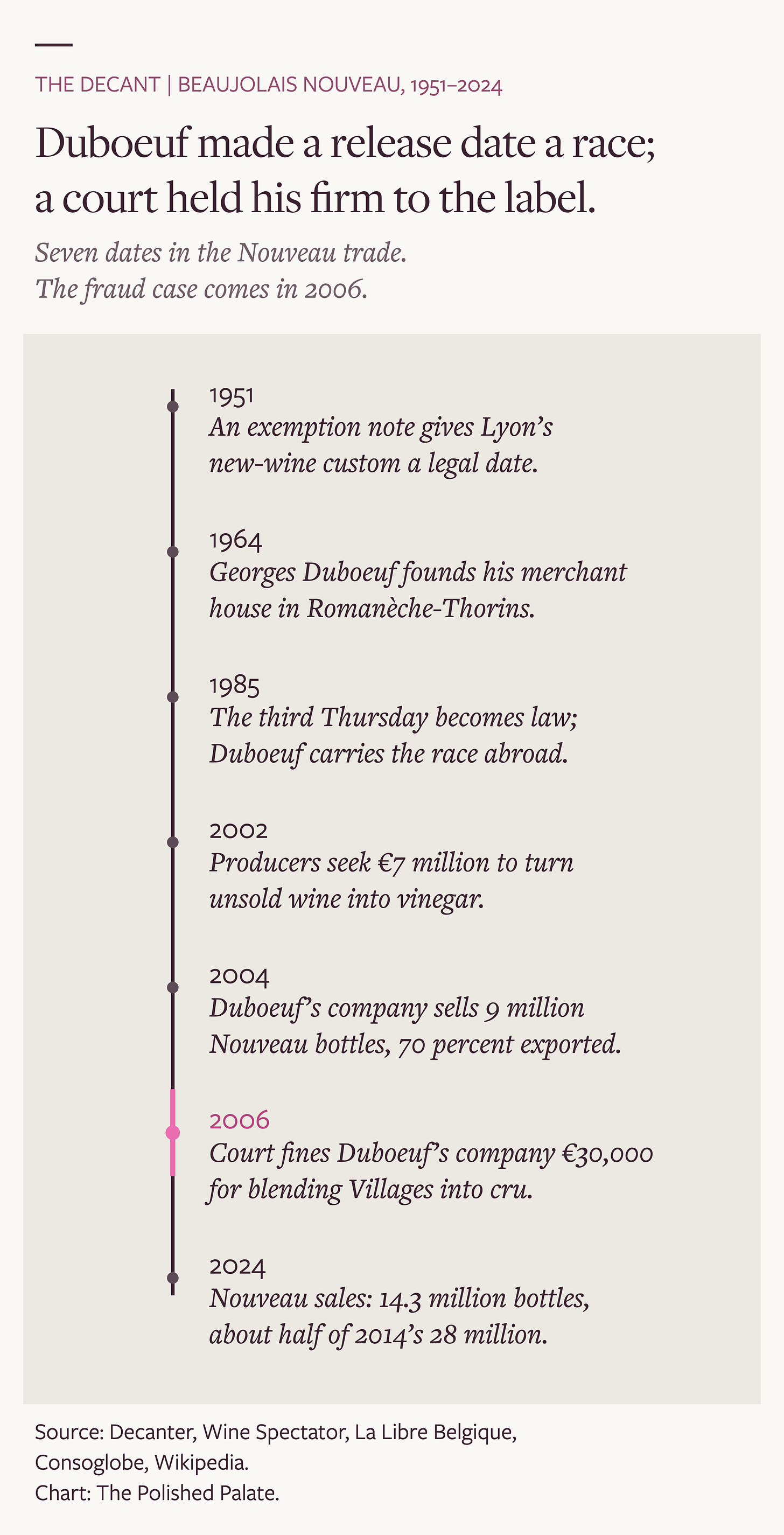
Georges Duboeuf, a merchant from the edge of the Mâconnais who started out delivering bottles by bicycle, helped turn that permission into a race and sold the race in New York and Tokyo. At the height of it, Nouveau was more than half of everything Beaujolais produced. Then came a glut, a lawsuit over an insult, and a fraud conviction for his own company. The ten villages that make the region’s best wine, which are never allowed to be Nouveau, spent the same decades trying to build a name separate from it.
Duboeuf’s company sold those villages too. In 1968, according to a US retailer’s account of the partnership written with the grower’s family, Duboeuf agreed on a handshake to buy the entire harvest of a Morgon grower, Jean-Ernest Descombes, and the company still bottles that Morgon; by 2020 its range covered all ten crus. The village name on a Beaujolais label is the floor French law enforces, and in 2006 a court enforced it against Duboeuf’s own company. The producer decides how far above that floor the wine goes.
Pairing while you read: Georges Duboeuf’s Jean-Ernest Descombes Morgon, about $25.
The boy with the bicycle
Duboeuf was born on April 14, 1933, into a winegrowing family at Chaintré, in the Pouilly-Fuissé appellation, white-wine country just north of Beaujolais (Decanter gives neighboring Crêches as his birthplace). The family’s 15 acres of vines gave them a poor living, and like most growers they sold their wine in bulk to merchants. His father died when Georges was 3. At 16 he quit school to work on the farm.
He turned 18 in April 1951, seven months before the note that gave Nouveau its legal date, and that was when he decided to sell the family’s wine himself. He put a couple of bottles in a backpack and rode his bike to restaurants in the area. At Au Chapon Fin in Thoissey, the chef Paul Blanc tasted the wine, bought it, and asked him to find more. That request made him a merchant.
He sold his neighbors’ wines to restaurants across the region, choosing and bottling each one himself, which set him apart from most merchants of the time, and in 1964 he founded Les Vins Georges Duboeuf in Romanèche-Thorins. Four years later came the Descombes handshake, which the company’s American marketing describes as its first estate partnership. He designed many of the flowered labels himself.
His obituary in Wine Spectator says he earned a reputation for a discerning palate and helped growers raise farming and winemaking standards across the region. He believed in what Beaujolais made. “Our ace card is the style of wine,” he told Decanter in 2001. “It’s not like anywhere else. The fruit and the suave style cannot be repeated.”
How a release date became a race
Once the exemption put a date on the new wine, the date became the selling point, starting with a race to get the first bottles to Paris. In the 1960s, English clubs rewarded whoever drove the new wine back fastest. By the 1970s the release was a national event; in the 1980s it reached the rest of Europe and North America, and in the 1990s Asia.
Duboeuf carried it abroad. In the 1980s, Wine Spectator wrote, he lifted the release “from a local event to a worldwide celebration.” Bill Deutsch, who worked with him in the United States for 35 years, remembered one New York arrival: the cases rode the window washers’ platform up the outside of the World Trade Center to Windows on the World on the 102nd floor, where the wine director Kevin Zraly and Duboeuf opened the first bottle. American shops sold Nouveau as a Thanksgiving wine, since the holiday falls one week after release. This year that is November 26.
Volume grew with the publicity. In the late 1980s, Nouveau was more than half of the region’s production. Through the 1990s Beaujolais made 450,000 to 500,000 hectoliters of it a year, roughly 60 to 67 million bottles.
Japan became the biggest prize. In 1994 it imported about 800,000 bottles. La Libre Belgique reported in 2004 that Japan had been the largest market for Nouveau since 2001, and that year it bought about 12.5 million bottles. In November 2004 Duboeuf, then 71, attended his Japanese importer Suntory’s launch party at a Tokyo hotel for the second year running and told 300 invited guests the 2004 wine was fruity and easy to drink.
His company was the largest Nouveau merchant in the business, with 9 million bottles of it in 2004, 70 percent exported and close to 3 million sold in Japan. Across all its wines, reports at the time of his 2006 trial credited it with about a fifth of all Beaujolais production.
The wine that would not sell
The glut came first. In the summer of 2002, Beaujolais producers were asking the French state for €7 million to turn 100,000 hectoliters of unsold wine into vinegar. Asked by the Lyon monthly Lyon Mag why it was not selling, the taster François Mauss called much of it “a sort of lightly fermented and alcoholic fruit juice,” and the magazine quoted him saying producers were “conscious of commercialising a vin de merde.” Fifty-six cooperatives sued, and in 2005 the judgment against the magazine was overturned on free-speech grounds.
The fraud case came from the 2004 harvest. That September, Sylvain Doury, the winemaking director at Duboeuf’s Lancié facility, combined Gamay from cru vineyards in Brouilly, Côte de Brouilly, and Moulin-à-Vent with Gamay from lesser Beaujolais-Villages sites, so tanks meant for cru names held Villages grapes. French law forbids a cru wine from containing grapes from lesser vineyards. A routine audit by France’s consumer-fraud agency in January 2005 found the mixed grapes in the computer records; some tanks were labeled Villages and some cru, and all held the blend, about 200,000 bottles’ worth.
On July 4, 2006, the court in Villefranche convicted Les Vins Georges Duboeuf of fraud and attempted fraud and fined the company €30,000. The court found the blending was an effort to keep the quality of the wines consistent. Doury received a suspended three-month sentence. Duboeuf fired him and said he had known nothing of it. “I deeply insist that the mistake was due to the careless error of the winemaker,” he told Wine Spectator. “And I can only remind you that none of the incriminated wine was bottled or sold under the wrong classification.” The court was enforcing the label. The wine was reclassified as Beaujolais-Villages, the name its grapes allowed, and the company did not appeal.
How far Nouveau has fallen
Nouveau sales roughly halved in ten years. The trade sold 28 million bottles in 2014, 25.2 million in 2016, and 14.3 million in 2024. Japan, which bought about 12.5 million bottles in 2004, bought 1.9 million in 2024. In October 2025, Vitisphere reported that the trade expected sales to fall again despite a small, high-quality harvest. Vitisphere puts Nouveau at 22 percent of all Beaujolais sold. For a shopper, that means about four bottles in five from the region are something else.
One house, both sides of the line
The crus are ten named villages in the granite hills of the north, Morgon, Fleurie, Brouilly, Côte de Brouilly, and Moulin-à-Vent among them, and their wines sell under the village name. Nouveau may be made only under the Beaujolais and Beaujolais-Villages appellations, so no Nouveau carries a cru name. Writing in Decanter in 2015, James Lawther MW said the crus’ quality had been “somewhat hidden in the past by the influence of Nouveau, a lack of investment and, if truth be told, not enough decent winemaking.”
For a cru grower, the village name is the asset. The 2006 verdict held that a cru name on a label must mean grapes from that cru, even inside the house that made a fifth of the region’s wine. In December 2014 the crus left the body that managed all of the region’s appellations and set up their own; “We want to have a stronger presence so we can raise the standard of wine throughout the region,” their president, Audrey Charton of Fleurie, told Lawther. Growers also raised standards on their own terms. According to iDealwine’s 2010 obituary, Marcel Lapierre in Morgon set out from the early 1980s, on the advice of the researcher Jules Chauvet, to make wine without synthetic vineyard treatments, industrial yeasts, or sulfur, and he made a Beaujolais Nouveau alongside his Morgon.
Duboeuf died after a stroke at his home in Romanèche-Thorins in January 2020, at 86, with the business already run by his son Franck. On July 2 this year the importer and writer Terry Theise offered Duboeuf’s Beaujolais-Villages as an example of good commercial wine: “a dignified ordinary wine I might find mediocre,” he wrote, “but that’s a decided step up from schlock.”
That leaves two things true at once. The village name is the floor: it tells you where the grapes grew, and the law polices it. How the grapes were farmed and the wine was made is the producer’s work, which is why Theise could call a big house’s plain Villages a step up from schlock while finding it mediocre, and why the producer’s name matters once you are standing in front of the Morgons.
Duboeuf himself named the test. Conceding in 2006 that the verdict might make some consumers hesitant about Beaujolais, he told Wine Spectator they “only need to taste a bottle to allay their concerns.” So taste his Nouveau and a cru beside it. Choose the village first, then the producer. On the cru shelf, look for Clos de la Roilette Fleurie at about $25 to $30 and Château Thivin Côte de Brouilly at about $26 to $35. In Morgon, the same village name runs from Duboeuf’s Jean-Ernest Descombes at about $25 to Marcel Lapierre at about $40 to $45 and Jean Foillard’s Côte du Py at about $55 to $60.
The Finish
On a Beaujolais label, the village name is the floor French law enforces: a Morgon must come from Morgon, and in 2006 a court held the region’s most famous merchant to that. The producer works on top of the floor, which is why three Morgons on one shelf run from $25 to $60, and why one house could sell Nouveau, a decent Villages, and a Morgon at the same time. Read the village to know where the wine comes from, and the producer to know how well it was made.
One action for this week. If you buy the Nouveau tomorrow, buy one cru from the same shelf, a Fleurie or a Morgon at about $35, and open them side by side with dinner. Then decide which one you would buy again, and say why.
Pocket Palate: Beaujolais Nouveau
One card to keep:
- The race: Georges Duboeuf (1933 to 2020) carried the release abroad in the 1980s. In the late 1980s Nouveau was more than half of all Beaujolais made; in 2004 Japan bought about 12.5 million bottles.
- The glut: in 2002 the region sought €7 million to turn 100,000 hectoliters of unsold wine into vinegar. The “vin de merde” lawsuit that followed was overturned in 2005.
- The case: on July 4, 2006, Duboeuf’s company was fined €30,000 for mixing Villages Gamay into cru wine from the 2004 harvest. By his account, none of it was sold under the wrong label.
- The shrink: 28 million bottles of Nouveau sold in 2014, 14.3 million in 2024, 22 percent of all Beaujolais sold by Vitisphere’s count.
- The test: the village name is the floor, the producer works on top of it. A $15 Nouveau beside a $25 cru, including Duboeuf’s own Jean-Ernest Descombes Morgon.
Go Deeper
If this week’s idea stuck with you, these take it further.
- Gillian Sciaretta, Georges Duboeuf, Beaujolais Wine Legend, Dies at 86 (Wine Spectator, 2020): The bicycle, the chef at Au Chapon Fin, the Windows on the World arrival, and the American import numbers from peak to 2020.
- James Lawther MW, Beaujolais: Revival of the Fittest (Decanter, 2015): How the ten crus climbed out from under Nouveau, with the vineyard-area figures and the crus’ 2014 break from the regional body.
- Mitch Frank, Georges Duboeuf’s Company Convicted of Fraud (Wine Spectator, 2006): The contemporary report on the 2004 blending case, with the court’s finding, the fines, and Duboeuf’s own words.
- Oliver Styles, ‘Vin de Merde’ Case Closes in Favour of Freedom of Speech (Decanter, 2005): The end of the Lyon Mag lawsuit, and the 2002 vinegar subsidy that started it.
- Terry Theise, Are You Now or Have You Ever Been “Fine Wine?” (Terry Theise, 2026): An importer’s case for judging a wine by the purpose it was made for, with Duboeuf’s Beaujolais-Villages as his example of good ordinary wine.