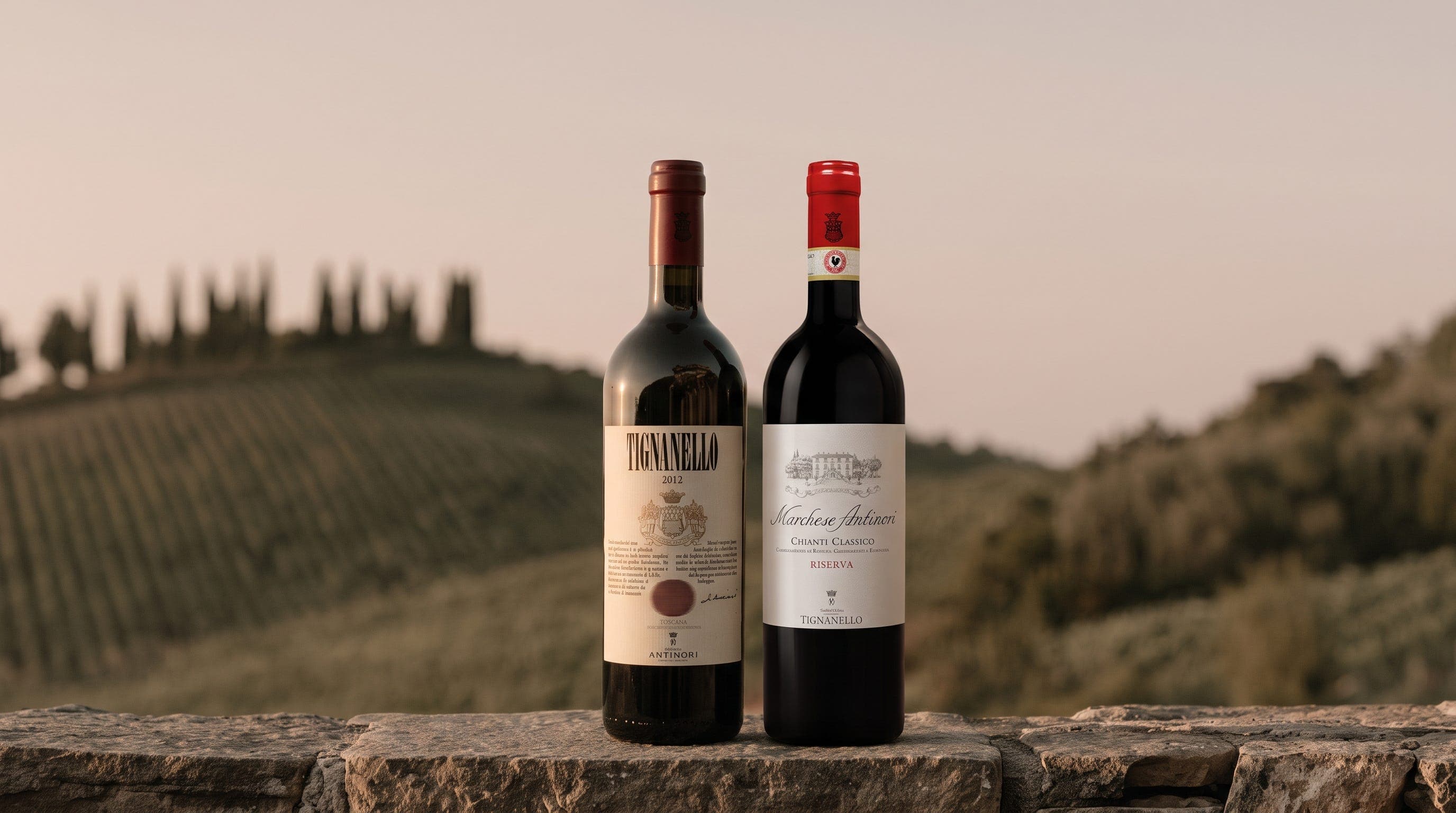
You are in the Italian aisle with a Chianti Classico in your hand, and the black rooster on the neck is part of why you picked it. It says a consortium checked this bottle against a rulebook: the right grapes, the right hills, a minimum of Sangiovese, a minimum time in the cellar before the word Riserva goes on. That is a reasonable thing to pay for.
Two shelves up, at about $185, sits a bottle from a vineyard inside the same Chianti Classico zone whose label carries no rooster at all, because in 1971 the family that farms it made a wine from that vineyard outside the rulebook, on purpose. Italian law had one category left for a wine like that, the bottom one: vino da tavola, table wine. The family put the vineyard’s name on the label, Tignanello, released it in 1974, and gave it, in Piero Antinori’s words, “the lowest classification and the highest price.” Today it costs nearly 4 times the $50 Riserva the same family grows on the same estate.
That history proves one thing clearly: a rulebook describes a style at the moment it is written, and the winemakers move first. The 1967 Chianti rule wrote down what good Chianti was agreed to be that year, white grapes included, so that a stranger could check a bottle against it. Antinori stepped outside that description in 1971. The trade moved second.
Neighbors inside Chianti Classico followed Tignanello out of the appellation within a decade, Isole e Olena with Cepparello from the 1980 vintage and Fontodi with Flaccianello from 1981, both pure Sangiovese sold as table wine because the rules still required white grapes, and by the 1980s the English-language press had a name for the whole category. The law moved last.
Chianti Classico’s grape rule changed 3 times, and only the third change, written in 2000, admitted a blend built the way Tignanello was built in 1975. For nearly 30 years, Tignanello could not legally be called Chianti Classico.
That order is worth knowing before you buy on the rooster: the stamp means a bottle matches a description, and that description can be decades older than what the best producers are making.
Pairing while you read: Marchese Antinori Chianti Classico Riserva, about $50, grown on the Tignanello estate and bottled under the rooster.
The rulebook of 1967
The Chianti DOC, written into law in 1967, set the recipe for Chianti Classico along with every other Chianti: Sangiovese as the base, the red Canaiolo beside it, and the white grapes Trebbiano and Malvasia at 10 to 30 percent of the blend. Giacomo Tachis, Antinori’s head of production from 1965 and later the man who blended both Tignanello and Sassicaia, was blunt about what the recipe produced in those years. In Tuscany, he said, Chianti “was a weak, cheap wine.”
I want to be fair to the rulebook here, because the consortium was not being stupid. A rule that says “10 to 30 percent white grapes” is an honest description of what Chianti was in 1967. The trouble was that the description stayed fixed while producers changed how they made the wine.
A Bordeaux recipe
Piero Antinori, from a family that has sold wine in Florence since 1385, took charge of the company in 1966, at 28, and the first thing he did, by his own account, was go to Bordeaux with Tachis, the company’s chief winemaker. Tachis had been going there for years to learn blending from Émile Peynaud, the University of Bordeaux enologist who consulted for the great châteaux.
By the end of the 1960s Antinori had become the first Italian winery to install barriques in quantity, and in the early 1970s Peynaud became its consultant. His advice, as Wine Spectator summarized it, came down to three things: cut yields, stop putting white grapes in Chianti, and age the wine in clean new oak barrels.
The second of those was the one the law forbade. The family already knew a wine outside the rules could work in Tuscan ground: Piero’s uncle by marriage, Mario Incisa della Rocchetta, had planted Cabernet Sauvignon on the coast at Bolgheri in 1944, and Tachis blended the first commercial release of that wine, the 1968 Sassicaia.
The wine that could not be called Chianti
The vineyard Piero chose sits on a single hillside of limestone-rich soil facing southwest at 350 to 400 meters, inside the Chianti Classico zone, on an estate the family acquired in the mid-1800s. The 1970 from that parcel was still a Chianti Classico, made, in Wine Spectator’s account, with the smallest share of white grapes the rule allowed, and aged in small oak barrels.
The 1971 left the white grapes out, and that alone barred it from the Chianti Classico name. It could not carry a place name at all, so it took the vineyard’s name and the lowest classification Italian law offered, and came out in 1974. Asked in 2025 what that “highest price” had been in the United States, Piero answered: approximately $6.
In the mid-1970s Antinori left the Chianti Classico consortium, and it did not rejoin until 2012. The 1975 Tignanello, by Wine Spectator’s account, had 15 percent Cabernet Sauvignon and 5 percent Cabernet Franc beside the Sangiovese, and the family says the blend has kept its current shape since 1982. In 1978 the other half of the hillside got its own label, Solaia, with Cabernet in the lead.
Chianti’s grape rule changed 3 times
The trade needed a name for the wines that had left, and by the 1980s the English-language press was calling them Super Tuscans. Nobody agrees who said it first; the credit has gone to Luigi Veronelli, David Gleave, Burton Anderson, and Robert Parker.
Then the grape rule changed 3 times, and every change ran in Tignanello’s direction. In 1984, when Chianti became a DOCG, Sangiovese rose to 75 to 90 percent, white grapes fell to a 2 to 5 percent minimum, and other red grapes such as Cabernet were allowed up to 10 percent. In 1996 Chianti Classico got its own DOCG rulebook, and 100 percent Sangiovese was authorized for the first time, which made the white grapes optional. That rulebook still capped other red grapes at 15 percent, too little for a blend with 20 percent Cabernet. The third change, written in 2000, set Sangiovese at 80 percent minimum, raised other red grapes to 20 percent, and phased the white grapes out; Chianti Classico has been red grapes only since the 2006 vintage.
Set the current code against the 1975 Tignanello: 80 Sangiovese, 15 Cabernet Sauvignon, 5 Cabernet Franc, from a hillside inside the zone. On the grape rule, the one that kept it out, that blend fits Chianti Classico and Chianti Classico Riserva today.
It would not fit Gran Selezione, the top tier created in 2014, which from the 2027 vintage requires at least 90 percent Sangiovese and allows only native Tuscan grapes beside it. The code also sets yields, aging and bottling rules, which I have not checked against Tignanello. Today’s rulebook bans the ingredient the rulebook of 1967 required, and Tignanello has been made without that ingredient since 1975.
Why it stays outside
Antinori has had a way back for years. The family rejoined the consortium in 2012, and it bottles the Marchese Antinori Riserva from the same estate under the rooster. Tignanello still carries Toscana IGT. Going by price, the stamp would add little: under the IGT label Tignanello sells for nearly 4 times the rooster bottle from the same estate, and for 3 to 4 times the best Riservas from estates that kept the rules the whole time. I have not found Antinori explaining the choice on the record; the price gap is the plainest reason in view.
What the bottles cost now
All prices here are United States retail, 2026, rounded. Tignanello averages about $185 a bottle. Marchese Antinori Chianti Classico Riserva, grown on the same Tenuta Tignanello and bottled under the black rooster, is about $50; Wine Spectator listed the 2020 at $50 when it put the wine at number 7 on its 2023 Top 100.
A very good Riserva from an estate that kept the rules the whole time costs about the same: Castello di Volpaia’s averages about $46, Fèlsina’s Rancia about $60. Solaia averages about $415. In November 2024, Christie’s sold two bottles of the 1971, the vintage Piero recalls retailing in the United States for about $6, for £813 and £750 with premium, above their estimate of £300 to £500.
Nothing in this history tells you whether Tignanello tastes 4 times better than the Riserva from the same estate. The price reflects the reputation the name has built since 1974 without the rooster.
The same family sells to you at every price on the shelf. Santa Cristina Rosso Toscana is about $12 to $14. Villa Antinori Rosso Toscana is about $20. Pèppoli Chianti Classico, rooster on the neck, is about $22. The Marchese Antinori Riserva is about $50.
The Finish
The rules caught up, and today the rooster can separate two very similar bottles. Pèppoli, under the rooster, is Sangiovese with a little Merlot and Syrah. Villa Antinori Rosso, under the Toscana IGT label, blends Sangiovese with Cabernet, Merlot, Syrah and Petit Verdot. Same house, about the same price, one stamped and one not.
Buy both. Have someone pour them blind, side by side, and before you look, name the one you think carries the rooster and say why: brighter acidity, sour cherry, a firmer grip, whatever Chianti means to you. If you pick it out for reasons you can name, the stamp marks a difference you can taste. If you cannot tell them apart, or you keep refilling the IGT, the stamp only tells you which rulebook the grapes were grown under, and you have learned how much of the rooster to pay for.
The rooster on any bottle certifies that the wine fits a description a committee wrote down, and Tignanello’s blend fit that description about 30 years after Antinori took the 1971 vintage out of the rules.
Pocket Palate: Tignanello
One card to keep:
- What it is: Antinori’s single-vineyard red from the Tignanello hillside inside Chianti Classico. First vintage under the Tignanello name 1971, released 1974 as vino da tavola; Toscana IGT since the 1994 vintage.
- What broke the rules: the 1967 Chianti DOC required 10 to 30 percent white grapes. The 1971 left them out; from 1975 the blend has had Cabernet Sauvignon and Cabernet Franc beside the Sangiovese, aged in barriques.
- How Chianti’s grape rule moved, 3 times: 1984 cut the white minimum to 2 percent and allowed other red grapes up to 10 percent; 1996 allowed 100 percent Sangiovese, other reds up to 15; 2000 set 80 percent Sangiovese, other reds up to 20, and phased out white grapes (gone from the 2006 vintage).
- Then and now: about $6 US retail at the 1974 release, by Piero Antinori’s account; about $185 in 2026. Two bottles of the 1971 sold for £813 and £750 at Christie’s in November 2024.
- Same house on the shelf (2026): Santa Cristina Rosso Toscana about $12 to $14; Villa Antinori Rosso Toscana about $20; Pèppoli Chianti Classico about $22; Marchese Antinori Chianti Classico Riserva, grown on the Tignanello estate, about $50.
Go Deeper
If this week’s idea stuck with you, these take it further.
- Chris Mercer, Historic Tignanello 1971 Vintage Beats Auction Estimate (Decanter, 2024): The Christie’s 50th-anniversary sale lot by lot, with Piero Antinori’s and Renzo Cotarella’s comments on how the wine has changed since the 1990s replanting.
- Mitch Frank, The Family Trust (Wine Spectator, 2016): A long portrait of the family at the moment of succession: the 1966 flood and recall, the Peynaud years, the Sassicaia arrangement, and the three daughters in their own words.
- Michele Shah, Founding Father: Giacomo Tachis (Decanter): Tachis interviewed in retirement on Peynaud, the first barriques, blending the 1968 Sassicaia, and why he thought Italian winemakers were in too much of a hurry.
- Bill Nesto MW and Frances Di Savino, Chianti Classico: The Search for Tuscany’s Noblest Wine (University of California Press, 2016): The scholarly history of the appellation from the 1716 Medici edict to the modern rulebook, an André Simon award winner.
- Production Code of “Chianti Classico” DOP Wine (Consorzio Vino Chianti Classico): The current rulebook itself, in English. Article 2 is the grape recipe: Sangiovese 80 to 100 percent, other red varieties up to 20, no white grapes anywhere in the text.